Cockpit Domain Controllers (CDC): Architecture and Benefits in SDVs
Oct 29, 2025
-27 mins read
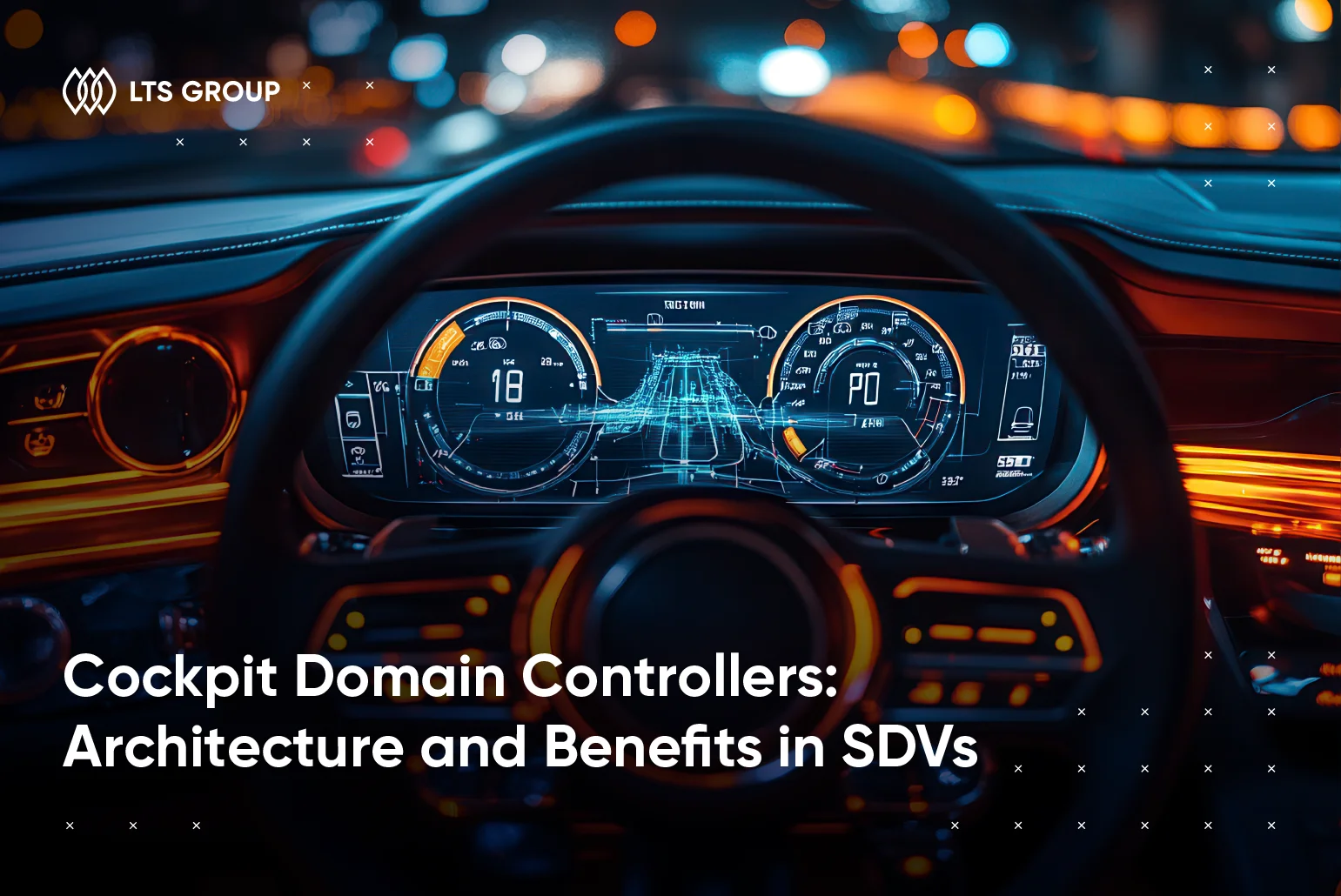
The modern vehicle is rapidly evolving into a sophisticated digital platform where software defines the driving experience. From immersive infotainment to advanced driver assistance, today’s cockpit has become the centerpiece of interaction between humans and machines. Behind this transformation lies the Cockpit Domain Controller (CDC) – a centralized computing hub that brings together previously fragmented cockpit functions into one powerful system.
As vehicles become increasingly connected and software-centric, the CDC plays a pivotal role in ensuring seamless user experience, optimized system performance, and scalable architecture for future innovation. Closely tied to emerging frameworks like AUTOSAR and the broader shift toward Software-Defined Vehicles (SDVs), the CDC represents not just a hardware consolidation but a paradigm shift in how automotive software is designed, developed, and deployed.
In this article, we will explore what a CDC is, how it integrates with AUTOSAR, its architecture, advantages, and the challenges involved in development. We will also highlight how specialized software development approaches can accelerate innovation and deliver high-quality cockpit solutions.
What is a Cockpit Domain Controller (CDC)?
A Cockpit Domain Controller is a centralized computing unit that integrates multiple cockpit functions into a single platform, replacing the traditional approach of having separate ECUs (Electronic Control Units) for each subsystem. These functions typically include:
- Instrument clusters that display speed, fuel levels, and warnings.
- Infotainment systems handling navigation, media playback, and connected services.
- Head-Up Displays (HUDs) providing essential driving information without distracting the driver.
- Driver information systems, such as alerts, notifications, and advanced interfaces like gesture or voice recognition.
Previously, each of these systems relied on its own ECU, leading to complex wiring, higher costs, and integration challenges. By consolidating these functions, a CDC simplifies the vehicle’s electronic architecture, reduces hardware overhead, and enables a unified, seamless cockpit experience.
The CDC is not only about hardware centralization. It also provides a software platform capable of supporting high-performance applications, real-time processing, and scalable upgrades. Modern CDCs are designed to handle graphically rich displays, responsive HMIs, connectivity features, and integration with cloud services, all while maintaining reliability and safety.
In essence, the CDC serves as the brain of the cockpit, orchestrating multiple subsystems and ensuring that both safety-critical and user-focused applications operate harmoniously. Its role becomes even more crucial in the context of Software-Defined Vehicles (SDVs), where flexibility, OTA updates, and cross-platform compatibility define the vehicle’s value proposition.
Key components of the cockpit domain controller
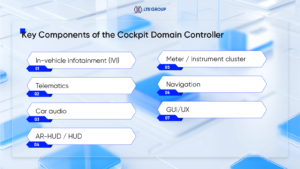
1. In-vehicle infotainment (IVI)
The IVI system is the entertainment and information hub inside the vehicle. It integrates a wide range of functions, including:
- Music, video, and multimedia playback.
- Smartphone integration via Bluetooth or USB.
- GPS navigation and real-time traffic updates.
- Voice assistants and connected applications.
By consolidating these features, IVI not only makes driving more engaging but also improves safety by enabling hands-free control. Modern IVI platforms are increasingly cloud-connected, supporting OTA updates and third-party apps, ensuring drivers and passengers enjoy the latest digital services without replacing hardware.
2. Telematics
Telematics extends cockpit capabilities beyond the vehicle itself through wireless communication and data management. Its functions include:
- Remote vehicle monitoring and control.
- GPS-based location tracking and navigation support.
- Emergency call systems (eCall) for accidents or breakdowns.
- Remote diagnostics and over-the-air software updates.
By providing continuous streams of vehicle and operational data, telematics enhances fleet management efficiency, predictive maintenance, and driver safety. In the context of CDCs, telematics ensures that cockpit systems are seamlessly integrated with external networks, paving the way for connected and autonomous mobility.
3. Car audio
Car audio remains an essential part of the in-vehicle experience. Modern car audio systems go far beyond traditional radio playback to include:
- Multi-channel speakers with immersive surround sound.
- Amplifiers and sound processors tailored to vehicle acoustics.
- Voice command integration for safer control while driving.
- Seamless connectivity with mobile devices for personalized entertainment.
By managing audio through the CDC, automakers can deliver consistent sound quality across multiple cockpit functions, integrating it tightly with infotainment, navigation, and HMI features. This elevates not just comfort but also driver concentration and passenger enjoyment.
4. AR-HUD / HUD (Augmented Reality Head-Up Display)
The Head-Up Display (HUD) projects essential driving information directly onto the windshield or a transparent display, enabling drivers to keep their eyes on the road. With Augmented Reality HUDs (AR-HUDs), the system overlays digital elements, such as navigation arrows or hazard warnings, onto the driver’s real-world view.
Benefits include:
- Reduced driver distraction by minimizing eye movement.
- Enhanced situational awareness with real-time AR guidance.
- Improved safety in complex traffic conditions.
By integrating HUD into the CDC, the system ensures that safety-critical data is processed with low latency while maintaining synchronization with navigation and infotainment functions.
5. Meter / Instrument cluster
The instrument cluster is the core display for essential vehicle data, such as:
- Speed, RPM, and fuel level.
- Oil pressure and engine temperature.
- Warning lights and diagnostic messages.
Modern digital clusters are multi-functional displays capable of real-time data processing and seamless communication with other cockpit systems. With CDC integration, the instrument cluster can switch dynamically between views, display navigation information, and synchronize alerts with infotainment or HUD systems.
6. Navigation
Navigation systems have evolved from standalone GPS devices to integrated platforms powered by cloud data and AI. Key capabilities include:
- Real-time route optimization based on traffic conditions.
- Obstacle and hazard warnings.
- Fuel-saving recommendations through efficient routing.
- Integration with AR-HUDs for intuitive lane-level guidance.
By consolidating navigation into the CDC, automakers reduce system redundancy and create a unified interface where maps, alerts, and cluster data work seamlessly together.
7. GUI/UX (User interface and user experience)
The GUI/UX is the interface and interactive experience through which drivers and passengers control the cockpit systems. It defines how drivers and passengers interact with all cockpit functions, from touchscreens and voice assistants to gesture controls.
Trends shaping automotive GUI/UX include:
- Simplification: Reducing clutter and making interfaces intuitive.
- Consistency: Unified design language across cluster, IVI, and HUD.
- Safety-first design: Prioritizing minimal distraction while maximizing usability.
- Personalization: Adaptive layouts that adjust based on driver preferences.
The CDC enables this by centralizing data and ensuring that interaction flows remain consistent across multiple displays and systems. In other words, GUI/UX is the human touchpoint of the CDC, directly influencing both satisfaction and safety.
Driving Forces Behind the Rise of Automotive Cockpit Domain Controllers
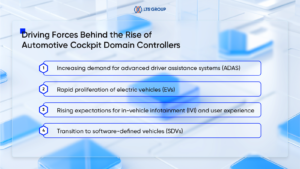
Increasing demand for advanced driver assistance systems (ADAS)
As awareness of road safety grows and global regulations become stricter, consumers expect vehicles to be equipped with advanced safety assistance systems. ADAS has become a core element in reducing accidents and enhancing driver confidence.
To deliver these safety features effectively, cockpit domain controllers (CDCs) must handle complex sensor data processing and integrate outputs from cameras, radars, and LiDARs in real time. This ensures stable, reliable performance and smooth communication between ADAS and the driver via instrument clusters or head-up displays.
According to Statista, the global market size for ADAS reached USD 58 billion in 2024 and is projected to grow to over USD 125 billion by 2029. This rapid expansion is driving global automakers to heavily invest in sensor technology, data processing platforms, and high-performance CDCs that support intelligent driving functions.
Rapid proliferation of electric vehicles (EVs)
The transition to electric mobility is no longer just about environmental responsibility – it has become a strategic necessity for the future of the automotive industry. Unlike traditional internal combustion engine (ICE) vehicles, EVs feature far more complex electrical and electronic architectures, requiring advanced management of batteries, electric motors, and energy distribution.
Within this landscape, the CDC is emerging as a key control platform. By consolidating diverse functions such as battery and energy management, driving performance optimization, and intelligent connectivity, the CDC addresses the technical demands of EVs while also enabling a differentiated, software-driven user experience.
According to Grand View Research, the global EV market size is valued at USD 1.328 trillion in 2024 and is forecasted to reach USD 6.523 trillion by 2030, growing at a CAGR of 32.5% (2025-2030). This exponential growth directly accelerates demand for high-performance CDCs capable of managing EV complexity at scale.
Rising expectations for in-vehicle infotainment (IVI) and user experience
For modern consumers, cars are no longer just a means of transportation – they are personalized digital spaces for entertainment, work, and communication. This shift raises new demands for in-vehicle infotainment (IVI) systems that deliver:
- Multitasking capabilities (streaming, navigation, video conferencing).
- Seamless smartphone integration (Android Auto, Apple CarPlay).
- Voice-based virtual assistants for hands-free interaction.
- Personalized recommendations and driver-specific interface settings.
The CDC plays a critical role in integrating and synchronizing multimedia systems while ensuring safe, distraction-free operation. With rising consumer expectations for connectivity and personalization, CDCs have become indispensable for delivering brand-defining user experiences that go beyond conventional hardware limitations.
Transition to software-defined vehicles (SDVs)
The emergence of the Software-Defined Vehicle (SDV) marks one of the most profound shifts in automotive history. Unlike traditional hardware-centric models, SDVs place software at the core of vehicle innovation – where features, services, and updates are delivered via software rather than hardware redesign.
In this paradigm, the CDC is the central computing hub of the SDV, enabling:
- Over-the-Air (OTA) updates: Automakers can remotely fix bugs, boost performance, and introduce new features, mirroring the smartphone model.
- Service and application integration: CDC’s flexible architecture supports AI assistants, third-party applications, and smart mobility services.
- Cost optimization: By consolidating multiple ECUs into one domain controller, OEMs reduce hardware duplication, wiring complexity, and lifecycle costs.
- Accelerated innovation: CDCs empower automakers to respond swiftly to market shifts, continuously expand features, and maintain competitiveness.
By acting as the digital backbone of the SDV, the CDC enables an ongoing innovation cycle, helping manufacturers deliver future-ready mobility experiences while optimizing operational efficiency.
Challenges Automotive Companies Face in Cockpit Domain Controller Development
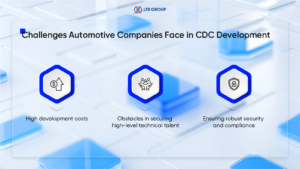
High development costs
Developing a cockpit domain controller is far more than simply designing electronic components; it represents a large-scale, cutting-edge research and development (R&D) endeavor. Key cost drivers include:
- Deployment of high-performance computing platforms to process real-time data from infotainment, telematics, ADAS, and HUD systems.
- Complex functional verification and testing to ensure reliability, low latency, and fault tolerance.
- Compliance with international safety certifications often involves time-consuming and resource-intensive procedures.
These requirements can result in substantial financial investment, posing difficulties for smaller automotive companies or those with limited R&D budgets.
To address these challenges, many global automotive companies are establishing Global Development Centers (GDCs) in cost-competitive regions such as Vietnam. This model goes beyond simple cost savings: it allows companies to maximize development efficiency, access skilled engineering talent, and maintain high project quality. With a strong local workforce, supportive policies, and a stable business environment, Vietnam has become an attractive location for long-term, sustainable automotive software development.
Obstacles in securing high-level technical talent
Successfully developing a CDC requires expertise across multiple domains, including:
- Embedded software engineering for real-time systems.
- Quality assurance and functional testing for integrated vehicle systems.
- Automotive-specific AI and machine learning for adaptive cockpit features.
- Project management and system architecture design to ensure seamless integration.
The automotive software industry faces a limited supply of engineers with these specialized skills, which makes assembling high-performing teams challenging.
To bridge this gap, many companies partner with specialized software development and IT outsourcing providers, often leveraging talent hubs like Vietnam. The country’s rapidly growing IT sector provides access to highly qualified engineers with strong technical capabilities and diverse expertise. This strategy enables companies to scale teams quickly, maintain project timelines, and accelerate innovation while avoiding the delays and costs associated with local talent shortages.
Learn more about Vietnam IT workforce solutions.
Ensuring robust security and compliance
Security and regulatory compliance are among the most critical challenges in CDC development. As the central control hub of the vehicle cockpit, a CDC integrates everything from IVI systems to core safety functions, making it a potential target for cyberattacks.
Historically, vulnerabilities in connected vehicle systems have demonstrated the severity of this risk. For instance, in 2015, security researchers remotely hacked a Jeep Cherokee’s Uconnect infotainment system, gaining control over brakes, steering, and engine functions, leading to a recall of over 1.4 million vehicles. This incident illustrates how a single security vulnerability can compromise driver safety and manufacturer reputation.
Automotive companies must therefore:
- Implement multi-layered cybersecurity measures both internally and across their supply chain.
- Partner with trusted suppliers and monitor their security capabilities.
- Adhere to international standards such as ISO/SAE 21434 for automotive cybersecurity.
Beyond security, CDCs must comply with functional safety and quality standards, including:
- ISO 26262 for functional safety.
- Communication standards such as AUTOSAR, CAN, LIN, and Ethernet require hardware-software compatibility and reliable connectivity.
- Software development standardization to ASPICE Level 3 compliance, ensuring consistent quality and risk management throughout the product lifecycle.
Meeting these standards demands significant investment, highly skilled personnel, and a robust quality management system, which may extend development timelines. Nevertheless, strict compliance is essential for avoiding legal risks, maintaining brand trust, and ensuring driver safety.
Future Trends in Cockpit Domain Controller Development
Market size
According to Global Market Insights (2025), the global CDC market is projected to grow from approximately USD 2.1 billion in 2024 to around USD 15.6 billion by 2034, reflecting robust growth over the next decade. This growth is driven by technological advancements, rising consumer expectations, and the increasing complexity of modern vehicles.
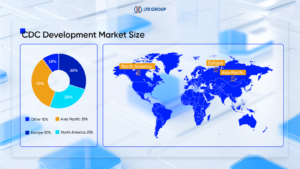
Analysis by vehicle type
Passenger vehicles
Passenger vehicles account for the majority of CDC market revenue. This growth is fueled by rising demand for advanced infotainment systems, multiple display screens, AI-driven user experiences, personalized services, and enhanced connectivity. As a result, the passenger vehicle segment is projected to achieve a CAGR of over 22% through 2034, according to Global Market Insights.
Commercial vehicles
While commercial vehicles represent a smaller market share, the segment is steadily expanding. In logistics and transportation fleets, digital cockpits, advanced displays, and connectivity solutions are increasingly deployed to enhance safety, improve operational efficiency, and support fleet management.
Regional analysis
The transition from multiple discrete ECUs to an integrated CDC architecture allows automakers to optimize hardware, reduce wiring complexity and vehicle weight, enhance software management, and deliver smoother, safer driving experiences. Major regions are shaping the CDC market in different ways:
North America
The North American market is valued at approximately USD 478.4 million. Growth is driven by vehicle weight reduction, multi-display integration, smart driver assistance, OTA software updates, and a shift to centralized cockpit architectures.
Europe
Europe’s CDC market is valued at around USD 582.9 million. Expansion is supported by safety and environmental regulations, premium brand differentiation through digital cockpit solutions, and software-centric architectures.
Asia-Pacific (APAC)
APAC holds the largest market share, accounting for approximately 42.3% of the global CDC market. The region benefits from large-scale automobile production, supportive government policies for EVs and autonomous vehicles, active local OEM investment, and intense competition among global players, accelerating market growth.
Future trends
As the automotive industry undergoes rapid transformation, several key trends are shaping the future of CDC development:
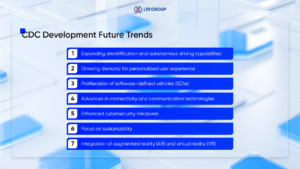
1. Expanding electrification and autonomous driving capabilities
The adoption of electric vehicles (EVs) and autonomous driving technologies is driving demand for CDCs that can efficiently manage energy distribution, integrate complex sensor inputs, and support ADAS functionalities. These capabilities are becoming essential as vehicles grow more complex and electrified.
2. Growing demand for personalized user experiences
Modern drivers expect intuitive, personalized cockpit experiences. Smart infotainment systems, AI-assisted controls, and adaptive user interfaces are now core vehicle features, all coordinated through the CDC. Personalization enhances convenience, comfort, and safety while driving.
3. Proliferation of software-defined vehicles (SDVs)
The industry’s shift toward software-defined vehicles places CDCs at the heart of software-driven innovation. They enable OTA updates, dynamic feature integration, and centralized management of vehicle functionalities, allowing manufacturers to continuously improve performance and user experience without hardware changes.
4. Advances in connectivity and communication technologies
With 5G networks and cloud-based services, CDCs must handle high-bandwidth data transfer, real-time communication, and secure connectivity. This trend drives demand for high-performance controllers capable of supporting robust infotainment, telematics, and V2X communication.
5. Enhanced cybersecurity measures
As vehicles become increasingly connected, cybersecurity remains a critical concern. CDCs require multi-layered security architectures to prevent cyberattacks, protect data privacy, and ensure driver safety. Manufacturers are investing heavily in advanced security features, which also influences CDC costs and market demand.
6. Focus on sustainability
Environmental concerns and stringent regulations are pushing CDC manufacturers to optimize energy efficiency and incorporate eco-friendly materials in production. Sustainable design is becoming a core consideration for next-generation cockpit controllers.
7. Integration of augmented reality (AR) and virtual reality (VR)
AR and VR technologies are increasingly leveraged in CDCs to deliver immersive infotainment experiences and advanced driver assistance displays. AR-HUDs provide contextual navigation, hazard warnings, and real-time traffic data directly in the driver’s line of sight, enhancing safety and engagement.
Case Study: Cockpit Domain Controller Successfully Implemented by LTS Group
LTS Group has extensive experience providing automotive software development and testing solutions, helping global clients ensure high-quality cockpit domain controller (CDC) implementations. The following case study highlights two major aspects of our CDC services: manual testing of infotainment systems and HMI application development.
Manual testing of infotainment systems
Business needs
Before releasing a CDC product to the market, the client required a dedicated testing team to ensure system quality, reliability, and compliance with industry standards.
Project information
- Country: Korea
- Domain: Automotive
- Development Process: V-Model
Scope of work
- Build and maintain an end-to-end manual regression test suite.
- Test all features comprehensively and report issues.
- Conduct test execution and reporting, including Exploratory, Functionality, Regression, Performance, Compatibility, Security, and Hardware Verification.
Challenges
- Rapid workforce expansion to meet high testing demands.
- Maintaining testing centers with automotive-specific capabilities while controlling costs.
- Over 1,200 hardware/software tests required for EV, HEV, PHEV, and FCEV vehicles.
- Utilization of approximately 400 simulation devices, including test benches, Vector CANoe, CANat, debug boards, software simulation, GPS, radio, camera, and mobile connectivity.
- Conducting tests across multiple environments and regions (EU, Russia, Australia, Türkiye, China).
Solutions provided by LTS Group
- Deployed a 60-person testing team capable of handling multiple vehicle models simultaneously.
- Prepared secure storage and facilities that met client safety and confidentiality requirements.
- Ensured rapid customs clearance of equipment within two weeks.
- Operated a dedicated testing site with advanced security systems.
- Executed software and hardware tests, applying best practices every six months to maintain testing quality.
Results
- 68,179 test cases executed
- 19,493 bugs identified
- 19,209 regression runs completed
- Project score: 98/100
HMI application development
Business needs
- Mobile applications must remain functional and stable even during conference calls or under unstable network conditions.
- Enable connection of two devices simultaneously via Bluetooth/USB, plus two additional devices via Android Auto and Apple CarPlay.
- Address performance issues such as app launch delays and call drops.
- Ensure synchronization with vehicle Cluster during calls.
Solutions implemented by LTS Group
- Collaborated closely with the Bluetooth team to accurately process all events sent to the HMI and ensure proper display on the screen.
- Optimized call information display by reducing rendering time, resizing images, and improving animations.
- Conducted regular weekly synchronization meetings and live sessions with the European team to quickly identify bottlenecks and provide solutions.
Development results
- 20 monthly bug fixes
- 35 monthly bug analyses
- Successfully addressed unstable network situations, ensuring smooth HMI performance under varying conditions.
FAQs on Cockpit Domain Controller
1. What is a Cockpit Domain Controller (CDC)?
A Cockpit Domain Controller is a centralized computing platform within a vehicle that integrates and manages all cockpit-related functionalities. This includes in-vehicle infotainment (IVI), telematics, car audio, instrument clusters, AR/VR head-up displays (HUDs), navigation, and human-machine interface (HMI) systems. CDCs simplify the vehicle’s electronic architecture by replacing multiple individual ECUs with a single, powerful platform.
2. Why are Cockpit Domain Controllers important in modern vehicles?
CDCs are crucial because they:
- Centralize vehicle functions, reducing hardware complexity and wiring costs.
- Enable advanced features like AI-driven infotainment, AR-HUD, and adaptive user interfaces.
- Support SDV capabilities, allowing over-the-air updates and software-defined vehicle functionalities.
- Enhance safety and reliability, particularly when integrating ADAS and telematics data.
3. How does a CDC differ from traditional ECUs?
Traditional ECUs are dedicated to specific vehicle functions (e.g., audio, navigation, or safety systems). In contrast, a CDC consolidates multiple ECUs into a single, high-performance platform capable of handling diverse functions simultaneously, improving system efficiency, scalability, and maintainability.
4. What are the key components of a Cockpit Domain Controller?
Typical CDC components include:
- IVI (In-Vehicle Infotainment): Multimedia, navigation, and voice assistants.
- Telematics: Remote communication, GPS tracking, and OTA updates.
- Car Audio: Speakers, amplifiers, and audio processing units.
- AR-HUD / HUD: Augmented reality displays for safe, heads-up information.
Instrument Cluster / Meter: Speed, fuel, and vehicle performance information. - Navigation Systems: Route planning and real-time traffic updates.
- GUI/UX (User Interface & Experience): Touch, voice, and gesture controls.
5. What are the main challenges in developing a CDC?
Key challenges include:
- High development costs: Integrating advanced hardware and software, testing, and safety certifications.
- Shortage of skilled talent: Expertise in embedded systems, automotive AI, QA, and project management is critical.
- Security and compliance: Ensuring robust cybersecurity and meeting standards like ISO 26262, AUTOSAR, and ASPICE Level 3.
6. Where can I learn more about CDCs and automotive software trends?
You can explore additional insights on AUTOSAR, software-defined vehicles, agile development, and IT outsourcing through resources like:
- What is AUTOSAR?
- Software-Defined Vehicle
- Agile Software Development Lifecycle
- Software Development Companies in Vietnam
Conclusion
Cockpit domain controllers (CDCs) are at the heart of next-generation automotive innovation, integrating infotainment, human-machine interfaces, and vehicle control while enabling EVs, autonomous driving, 5G connectivity, and OTA updates.
LTS Group has consistently demonstrated the ability to accelerate time-to-market, enhance user experiences, and uphold international standards through a combination of skilled embedded engineers, automated and manual testing teams, and agile development practices.
Backed by certifications such as ISTQB, PMP, PSM, and ISO standards (ISO 9001, ISO 27001), alongside expertise in AUTOSAR, Automotive SPICE, CANoe, MATLAB Simulink, Qt/QML, and Yocto, we are proud to deliver reliable, scalable, and high-performance CDC solutions.
By partnering with LTS Group, automotive companies gain a trusted collaborator capable of navigating the complexities of CDC development, driving innovation, and delivering safe, intelligent, and seamless in-vehicle experiences that meet the demands of modern drivers.

Share


LTS Group
LTS Group is an IT outsourcing services provider who will go the extra mile to help businesses worldwide break barriers to achieve growth. With a vast pool of talented developers and testers owning experience in a range of domains, we aim to enhance your competitiveness with superior IT outsourcing projects.

More must-reads to keep leaders updated
LTS Group & IndidLab Sign MOU for Strategic Collaboration in AI, Computer Vision, Spatial AI, and GIS
Sep 14, 2026
-3 mins read
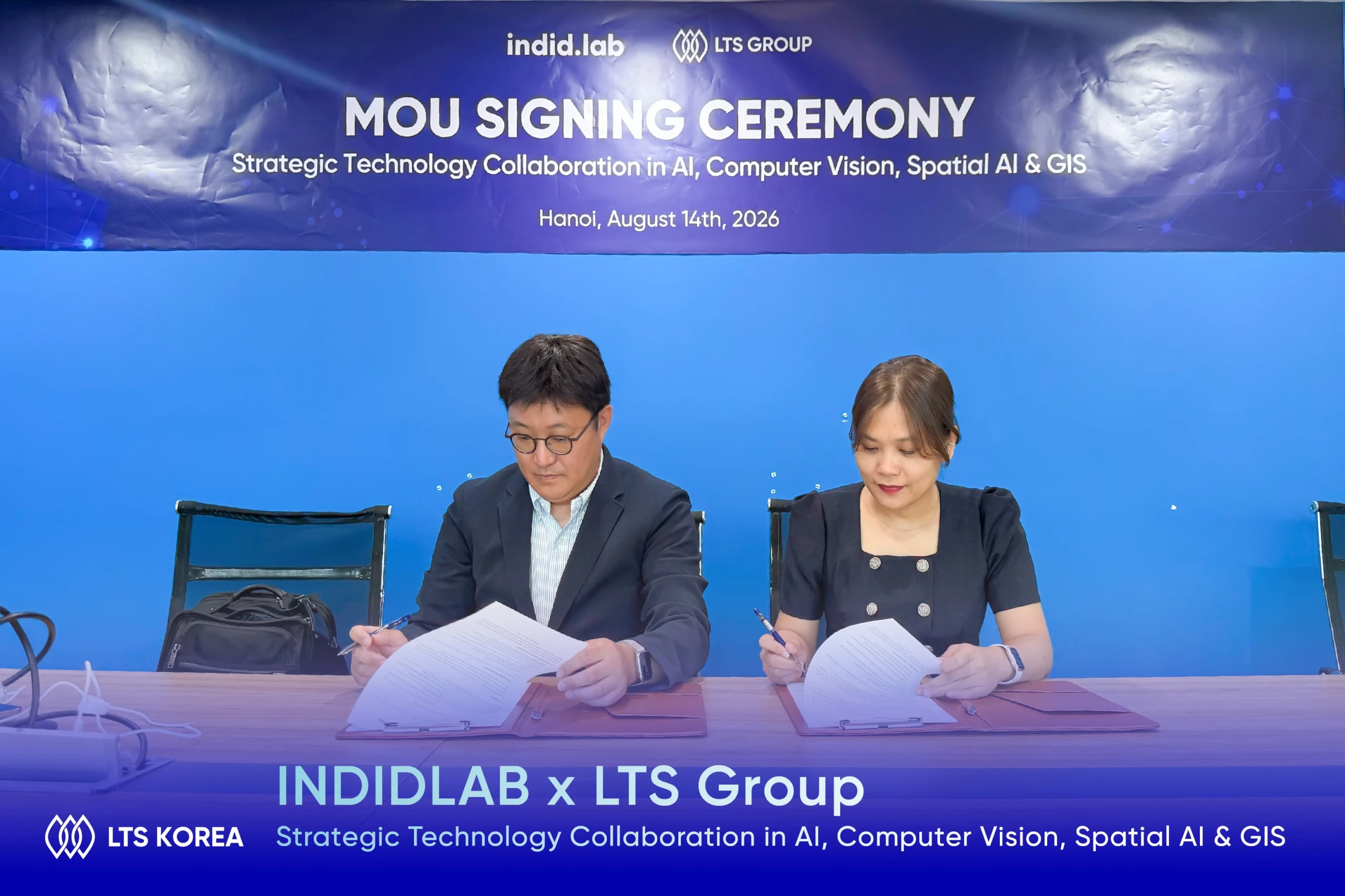
Vietnam-based IT solutions company LTS Group, led by CEO Xuan Phung, and South Korean Spatial AI and PropTech company IndidLab, led by CEO Yohan Jung, signed a Memorandum of Understanding (MOU) on August 14 at LTS Group’s headquarters in Hanoi. The agreement marks the beginning of strategic technology collaboration in AI, computer vision, Spatial AI, and Geographic Information Systems (GIS). Before the signing, both companies introduced their businesses and shared key project experience. LTS Group presented its AI and software development and AI training data capabilities and relevant case studies, while IndidLab outlined its work in converting data from formats such as maps and CAD files into GIS and geospatial data. As much of this conversion process is still performed manually and requires significant time, IndidLab is exploring an AI-powered automation solution and seeking a technology partner to support its development. During the meeting, the two companies discussed potential technical approaches for IndidLab’s ongoing projects. The discussion covered LTS Group’s capabilities in AI, computer vision, OCR, Document AI, and data labeling, as well as opportunities for a Proof of Concept (PoC) and long-term collaboration. LTS Group’s Head of AI also joined the meeting, contributing technical expertise and supporting in-depth discussions on potential implementation approaches. Although IndidLab has made several visits to Vietnam, the company noted that this marks its first substantive collaboration with a Vietnamese business. Since 2024, IndidLab has been expanding into Vietnam and Hong Kong and sees strong alignment between its technology direction and LTS Group’s capabilities. About IndidLab IndidLab is a South Korean PropTech company developing proprietary Spatial AI technology based on architectural and geospatial data. Its technologies are applied across real estate, urban redevelopment, and spatial intelligence services. The company won the Grand Prize in the 2024 Google Play ChangGoo Program and provides proprietary multi-family housing analysis data to the Korea Real Estate Board (KREB). Since 2024, it has also expanded its business into Vietnam and Hong Kong. About LTS Group Established in 2016, LTS Group is a fast-growing Vietnamese IT service provider. Formerly a leading Quality Assurance company in Vietnam (LQA), LTS Group has now grown into a diverse ecosystem of 8 entities, delivering end-to-end technology services including Software Development, Software Testing, Digital BPO, Global IT HR Services and IT Training Solutions. With 3 subsidiaries in the USA, Japan, and South Korea, we serve 60+ clients across more than 11 countries with a satisfaction rate of 97%. These milestones strengthen our service quality and drive us toward our 2027 goal of becoming a world-class IT service company.
Meet LTS Group at AI Summit Seoul & Expo 2026
Aug 10, 2026
-2 mins read
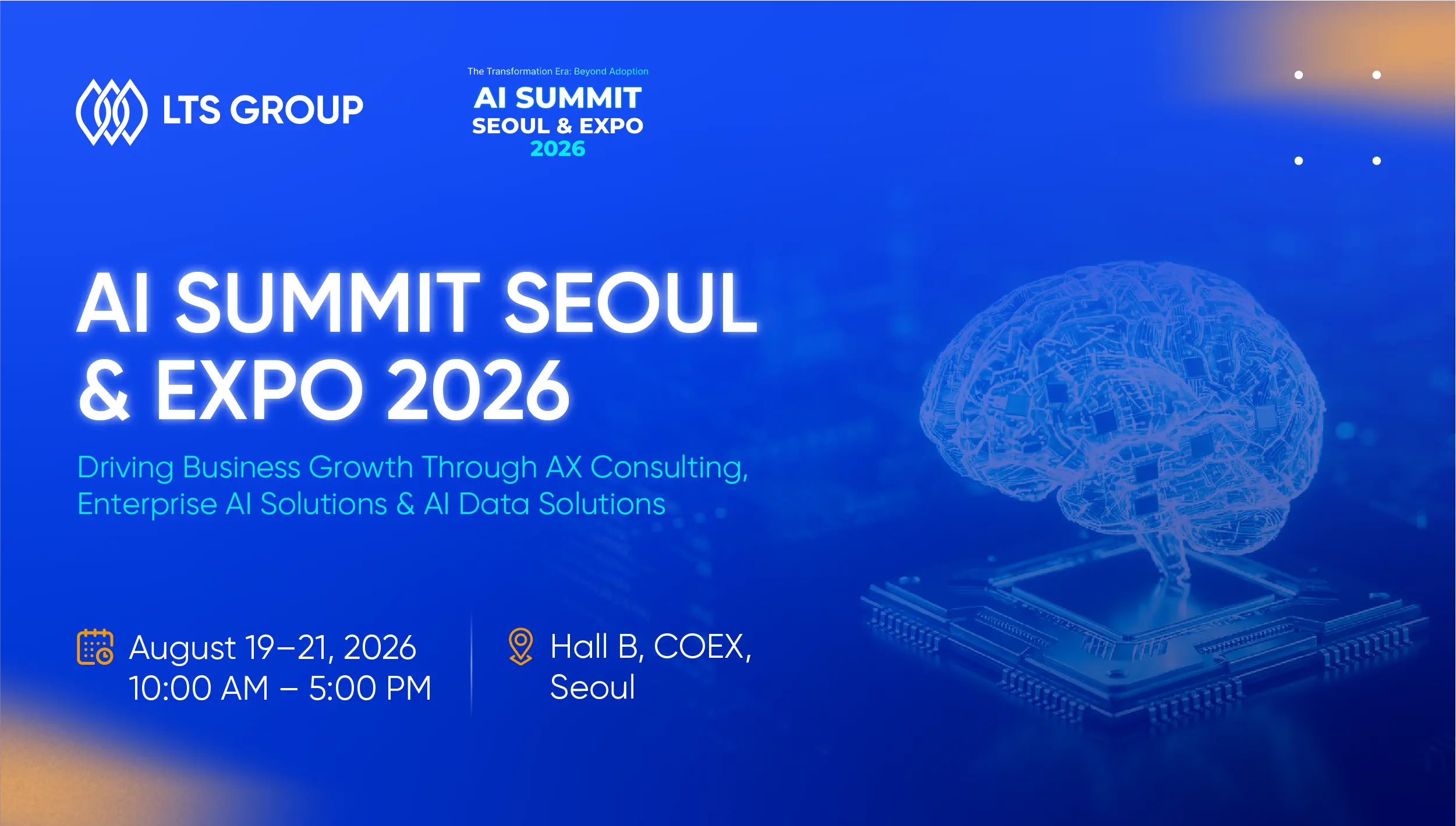
LTS Group will participate in AI Summit Seoul & Expo 2026, Asia’s largest AI event, taking place at COEX in Seoul from August 19 to 21, 2026. About AI Summit Seoul & Expo 2026 Held annually in Seoul since 2018, AI Summit Seoul & Expo brings together experts from global enterprises, research institutions, and academia to explore the intersection of AI and industry. Now in its ninth year, the event will focus on AI agents, agentic AI, physical AI, and the latest strategies for AI adoption across industries. What LTS Group Will Showcase AI is evolving into a vertically integrated ecosystem connecting data, models, infrastructure, and applications. As agentic and enterprise AI gain momentum, businesses need strong software engineering and data capabilities to integrate AI into real-world operations and run it reliably at scale. At AI Summit Seoul & Expo 2026, LTS Group will introduce a comprehensive range of solutions supporting enterprise AI adoption and advancement: AX Consulting AI Software Development AI Data Solutions BEACON – Enterprise AI Solution, featuring a live on-site demo Our team will also be available to exchange market insights, introduce our technologies, and discuss how AI can support your business. Event Details Date: August 19–21, 2026 | 10:00 AM – 5:00 PM Venue: Hall B, COEX, Seoul | Booth I100 Visit the LTS Group booth to learn more about our Enterprise AI Solutions, AI Data Solutions, and BEACON platform. To arrange a meeting in advance, don’t hesitate to get in touch with us using the details below.
Meet LTS Group at Intersekt 2026 in Melbourne
Aug 10, 2026
-2 mins read
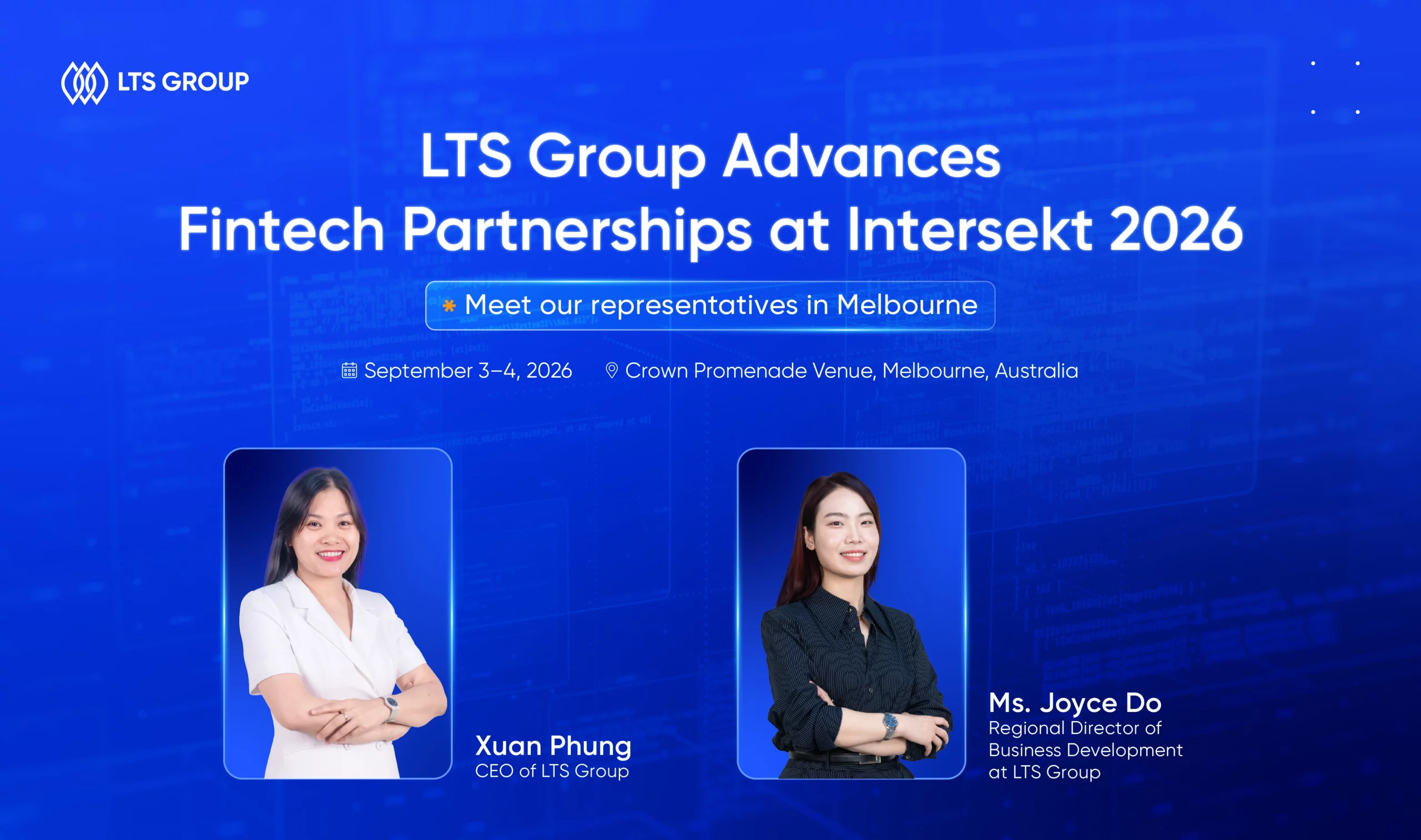
LTS Group is pleased to announce our participation in Intersekt 2026, taking place on September 3–4 at Crown Promenade Melbourne, Australia. Representing LTS Group at the event will be Mrs. Xuan Phung, CEO of LTS Group, and Ms. Joyce Nguyen, Regional Director of Business Development. They look forward to connecting with fintech leaders, financial institutions, technology providers, and innovators from across Australia and beyond. About Intersekt 2026 Hosted by FinTech Australia, Intersekt is one of Australia’s leading fintech gatherings. Now in its ninth edition, the event brings together more than 1,000 fintech founders, banks, investors, regulators, policymakers, and industry leaders to exchange insights and explore new opportunities across the financial services ecosystem. As the flagship event of Fintech Week Australia, Intersekt 2026 will feature industry sessions, roundtables, workshops, networking activities, and discussions focused on emerging technologies, market trends, policy developments, and the future of financial services. Connect with LTS Group at Intersekt 2026 At the event, our two representatives will introduce LTS Group’s AI-powered fintech software development capabilities and engage with businesses seeking to build, modernize, or scale their financial technology platforms. Our fintech experience covers digital banking, payments, lending, trading and investment, and financial analytics. We provide advanced data analytics, AX solutions, and legacy system modernization for lucrative AI adoption, combining domain knowledge with engineering and quality assurance capabilities to support each client’s business requirements and user needs. Mrs. Xuan Phung and Ms. Joyce Nguyen look forward to meeting industry professionals, exchanging perspectives on the evolving fintech landscape, and exploring potential technology partnerships at the event. Event details Date: September 3–4, 2026 Venue: Crown Promenade Melbourne Address: 8 Whiteman Street, Southbank, Victoria 3006, Australia If you are attending Intersekt 2026 and would like to discuss your next fintech initiative, connect with the LTS Group team to arrange a meeting in Melbourne.



Email:contact@ltsgroup.tech
Phone:(+84) 96-238-7474
Headquarters:17th Fl, MD Complex Office Building, 68 Nguyen Co Thach Street, Hanoi, Vietnam
Japan office:5F, Iwamoto Building, 3-20-10 Shibaura, Minato-ku, Tokyo 108-0023, Japan
US office:25787 Rawley Springs Dr, Chantilly, VA 20152
Korea Office:Seoul, Seocho-gu, Gangnam-daero 327, 12Fl, Room 1214