Generative AI: Applications, Limitations, Risks and Future Outlook
Jan 24, 2024
-17 min read

Generative artificial intelligence (generative AI, GAI, or GenAI) is a worldwide game-changer in the early 2020s. Its endless possibility of generating open-ended content across industries has caught the special attention of investors, organization users, and individual users right from its first years of debut.
So, what lay behind the hype? Let’s discover the applications, limitations, risks, and future outlook of generative AI with LTS Group right below.
What is Generative AI?
Generative AI is artificial intelligence capable of generating text, images, videos, and other media, using generative models.
As of early 2024, popular generative AI examples and their core functionality are as below:
- ChatGPT, Bard: text generation
- Midjourney, Stable Diffusion: image generation
- GitHub Copilot, AlphaCode: code-generation
- Podcast.ai: voice synthesis
- Synopsys, Cadence: chip design.
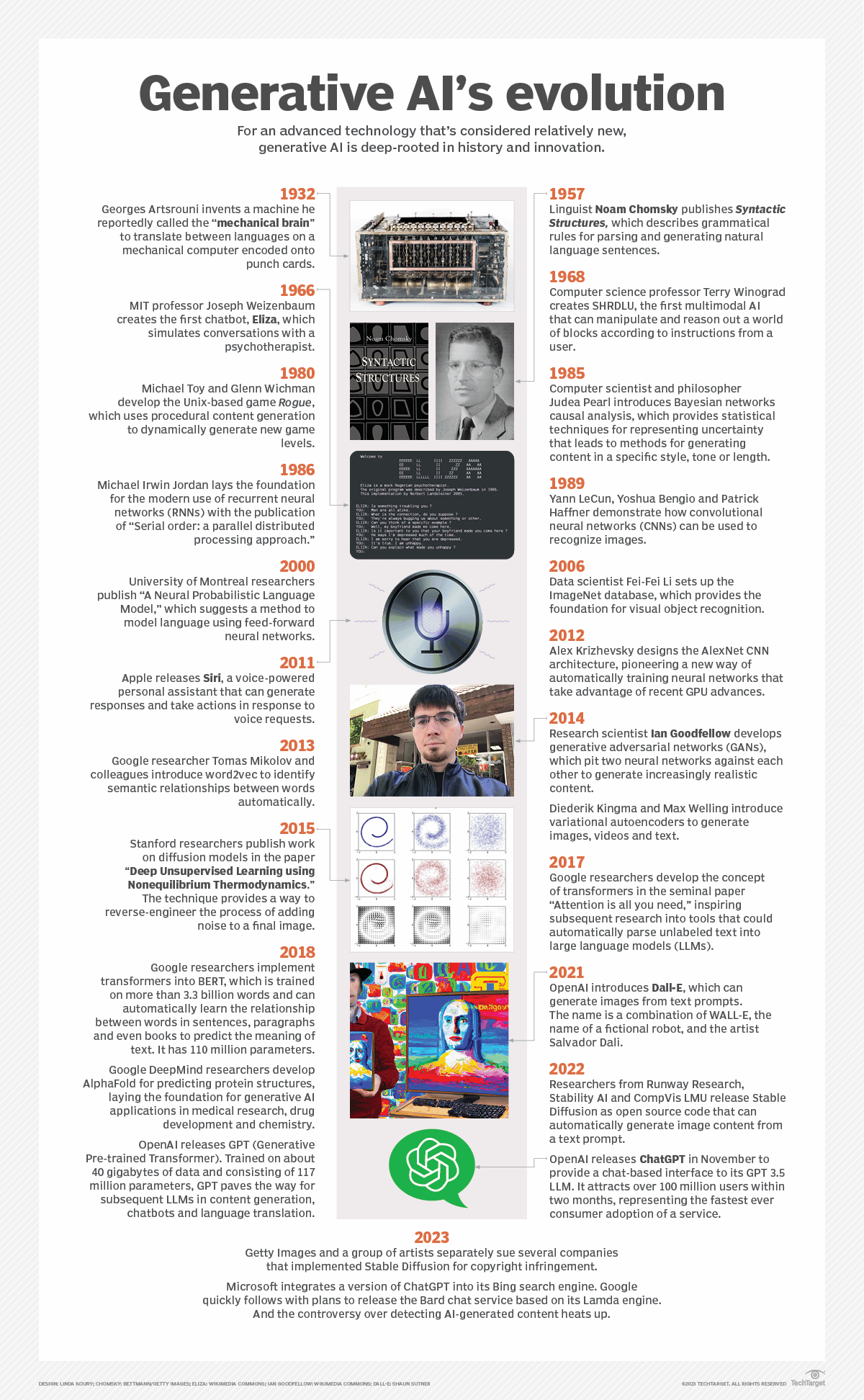
While the hype of generative AI started in the early 2020s after the debut and buzz of groundbreaking generative AI tools like ChatGPT and Bing Chat, the early seeds of generative AI evolution date back nearly a century.
How Does Generative AI Work?
Simply put, generative AI models like GPT-4, BERT, and OpenAI’s DALL-E learn the patterns and structure of their training data and then generate new data with similar vibes.
Generative AI works like a creative chef. It learns from a bunch of input examples, figuring out the recipes and flavors. When it’s in action, you toss in a prompt, be it in the form of a text, an image, a video, a design, musical notes, or any input that the AI system can understand, and it cooks up something new by mixing and matching what it learned. It’s like a chef making a dish based on their cooking experiences.
Common Generative AI Applications in Business
Generative AI, as it is so-called, is AI for digital item generation. At a high level, fundamental applications of generative AI that have been found are: text generation, image generation, video generation, speech generation, design creation, music composition, and even data augmentation.
From those fundamental applications, we have the most feasible applications of gen AI:

- Content creation: Generative AI can assist in producing high-quality and relevant content types such as AI art gen, AI image gen, generative image AI, AI text gen, AI story gen, and AI voice gen.
- Personalized customer interactions: By understanding customer preferences, generative AI can help businesses create personalized interactions, such as chatbots that tailor responses based on individual needs.
- Fraud detection: Generative AI can enhance security measures by identifying patterns and anomalies in data, contributing to more effective fraud detection in financial transactions.
- Product design optimization: Businesses can leverage generative AI to explore various design possibilities, optimizing product designs for functionality, aesthetics, and user experience.
- Demand forecasting: Generative AI can analyze historical data and market trends to provide accurate predictions for demand, helping businesses optimize inventory and production planning.
Furthermore, a wide range of gen AI use cases originates to solve industry-specific problems across various industries, including art, retail and eCommerce, healthcare, finance, gaming, marketing, education, manufacturing, and more to come.
Here are some ways generative AI applications impact specific industry verticals:
- Healthcare: Generative AI can be employed to analyze medical images, assisting in the early detection of diseases and providing more accurate diagnostics.
- Retail and eCommerce: Businesses can utilize generative AI for personalized shopping experiences, recommending products based on customer preferences and enhancing virtual try-on features.
- Education: Generative AI can aid in the development of personalized learning materials, adapting content based on individual student progress and providing targeted educational support.
- Finance: Generative AI plays a crucial role in risk assessment and fraud prevention, analyzing vast datasets to identify unusual patterns and potential security threats.
- Gaming: In the gaming industry, generative AI can enhance the creation of realistic graphics, generate dynamic storylines, and even adapt gameplay based on individual player behavior.
- Manufacturing: Manufacturers can employ generative AI to optimize production processes by predicting equipment maintenance needs, improving supply chain management, and utilizing computer vision for quality control.
Also, GenAI application development can be in the form of a web app, mobile app, desktop software, or integrated into existing platforms.
Outstanding Gen AI Tools: ChatGPT, Bard, and DALL-E 2
Let’s explore the most outstanding generative AI interfaces: ChatGPT, Bard, and Bing.

ChatGPT
What is ChatGPT?
ChatGPT is an AI-powered chatbot that generated buzz right from its first months of debut. The first version, utilizing OpenAI’s GPT-3.5 architecture, was released on November 30, 2022, followed by the GPT-4 version on March 14, 2023. Users can access any of the ChatGPT models based on subscription options.
ChatGPT has cognitive abilities like understanding the context and making sense of information to provide relevant and coherent responses. It uses natural language processing (NLP) to generate human-like cognitive answers in text. Its answer to the same question can vary for different prompts.
ChatGPT was considered the starter of the gen AI hype in late 2022 and early 2023, acquiring 1 million users just 5 days after launching and 100 million monthly active users after 2.5 months.
Noticing the incredible popularity of ChatGPT, Microsoft extended its investment in OpenAI from $1 billion in 2019 to $13 billion in 2023 and integrated a version of GPT into its Bing search engine.
Bard
Bard, or Google Bard, is a conversational generative AI chatbot developed by Google. Bard was initially built on the LaMDA family of large language models (LLMs), later upgraded to PaLM and then to Gemini. Basically, Bard and ChatGPT have similar functionality – generating cognitive text-based responses.
The popularity of ChatGPT coupled with the implementation of GPT into Bing rushed Google to introduce its Bard public-facing chatbot on March 21, 2023. Later that year, in October, Google released Assistant with Bard, a personal assistant powered by generative AI. Assistant with Bard has been expected to replace and augment Google Assistant’s existing capabilities.
ChatGPT and Bard have their strengths and weaknesses compared to each other. For example, Bard’s information is considered more up-to-date thanks to its real-time access to the internet. At the same time, many recognize ChatGPT as a better writer, especially in writing poems.
DALL-E
DALL-E is a text-to-image generation model that can create realistic images and art from a description in natural language. OpenAI introduced the first version, DALL-E in January 2021, while DALL·E 2 came out a year later, and DALL-E 3 debuted in October 2023.
DALL-E was trained on a large data set of images and their corresponding text descriptions. During actions, it uses this learned knowledge to generate new images based on provided text prompts. As a result, DALL-E models are the magic behind visually appealing images created by Bing Image Creator, Canva, and more.
You may want to know How to make an AI.
Limitations and Risks of Generative AI
So, what are the concerns around generative AI?

Limitations of generative AI
Bias and unintended outputs
Simply put, generative AI models learn from data during initial training, retraining, and active learning. If data is incorrect or carries biases, gen AI models can produce biased or inappropriate outputs.
Have you ever tried to manipulate ChatGPT’s responses by inputting leading questions or telling ChatGPT that its answers were incorrect? In such cases, it may return responses to your desired answer, especially when the responses are inferential and not fact-based.
AI hallucination
AI hallucination is when a LLM generates false or misleading information that is plucked from thin air, and presented as factual or accurate.
For example, when Google Bard was prompted “What new discoveries from the James Webb Space Telescope can I tell my 9-year-old about?”, Bard’s response included “JWST took the very first pictures of a planet outside of our own solar system”, which was wrong.
According to IBM, common reasons for AI hallucination are “sometimes AI algorithms produce outputs that are not based on training data, are incorrectly decoded by the transformer, or do not follow any identifiable pattern.”
Dependent on data
Generative AI models don’t possess independent thinking abilities. Although LLM models can cognitively create open-ended content, they don’t invent new knowledge but synthesize and reproduce the information they have been trained on.
Moreover, many LLMs are trained on data with cutoff dates, such as ChatGPT, and rely on people to feed new data, resulting in outdated information.
As a result, if the trained data is limited, the model’s outputs may also be limited.
Lack of maturity
As generative AI is in its early stages, many of its applications need more time to be fully tested for feasibility, impact, compliance, and risks. The hype of gen AI may subside as the reality of implementation sets in.
Also, according to Pitchbook, there seems to be a realization among founders and investors that some early companies were interesting experiments, but not great businesses.
So, what’s ahead is less a question of what generative AI can do and more a question of how each business will discover tailored applications and integrate them into its business model effectively and responsibly.
Risks of generative AI
Inaccurate AI-generated responses
This type of risk often occurs on the AI user side, associated with using incorrect AI-generated information or following incorrect AI-generated advice.
At an organizational level, it can hurt the ability of a business to function at different levels. For instance, including inaccurate AI-generated content in blog posts can harm brand reputation, while wrong demand predictions from AI-backed forecast models can result in business losses.
Model drift
Model drift, or model decay, happens when the accuracy of a model declines over time when production data differs from trained data. This can negatively affect the business KPIs.
An example of AI model drift could occur in an NLP model used for sentiment analysis in social media. Suppose the model is trained on data from a specific period and captures the sentiment patterns prevalent during that period. Over time, societal changes, language trends, or evolving sentiments may cause the model’s performance to decline as it encounters new data that differs significantly from its training set.
Legal risks
This type of risk often arises on the AI provider side, mostly associated with data privacy and copyright constraints.
AI models intensively consume data, so it’s crucial to handle data ethics, data privacy, and copyrights carefully—both for the data they were trained with and the data they generate.
But as the era of generative AI has just started, its regulations are still evolving. AI businesses either stay current with regulation changes, adhere to evolving regulations, or risk facing legal issues.
Moreover, generated content may unintentionally infringe on copyright or intellectual property rights, presenting additional legal challenges.
Responsible AI in the generative era
As a quick refresher, a gen AI model is trained on data in the form of text, voice, image, code, video, etc., and reproduces the information it has been trained on.
From there, it introduces concerns around fairness, toxicity, and intellectual property, among other things. Does its training data adhere to data privacy principles and is inclusive enough? Do its outputs respect intellectual property rights? Will people use its outputs for healthy purposes?
One example of a fairness concern is a recruitment screener trained on male-dominant performance data prefers male candidates over female candidates.
One instance of toxicity is deep fakes, created using AI algorithms, which have been misused for deceptive and toxic purposes.
In another scenario, gen AI tools might also infringe copyright by generating outputs that resemble existing works but don’t cite the sources.
To address such concerns, both the gen AI tool makers, lawmakers, and users take responsibility. Below are common possible actions on each side.
On the tool maker side:
- Ensure data fairness and data ethics by eliminating data bias and respecting data privacy principles. To avoid bias, be mindful of sampling, observer, interpretation, and confirmation biases. Additionally, safeguards data privacy through techniques such as anonymization, encryption, backup, and access control.
- Develop qualified detection technologies to combat AI-generated deep fakes and other toxic uses.
- Advocate for transparency and disclosure when utilizing AI-generated content, especially in scenarios where the source or authorship might be ambiguous.
On the lawmaker side:
- Introduce and improve laws that regulate the ethical use of generative AI, addressing issues such as fairness, privacy, and intellectual property.
- Work towards establishing industry standards and guidelines for the development, deployment, and usage of generative AI technologies.
- Facilitate educational programs for the public, policymakers, and businesses to raise awareness about the ethical considerations surrounding generative AI.
On the user side:
- Keep in mind that AI-generated content originates from existing knowledge bases, thus necessitating critical evaluation and cross-referencing to verify information.
- Ensure responsible and ethical utilization of AI-generated content for either informational or commercial intents.
- Provide constructive feedback to contribute to the development of responsible AI practices.
Gen AI and the Future of Work
Generative AI is knocking on the door of many industries and is poised to change many business functions. What will it mean for your workers?
According to the International Monetary Fund (IMF), “Advanced economies will experience the benefits and pitfalls of AI sooner than emerging market and developing economies, largely because their employment structure is focused on cognitive-intensive roles.”
But in general, gen AI can affect workers both positively and negatively.
First, gen AI may fade out many existing positions while adding job opportunities regarding its inputs and outputs.
- Jobs with high risks of replacement: routine data entry, basic customer support roles, etc.
- Jobs rise regarding gen AI inputs: jobs in the field of data science, such as data scientists, data annotators, data engineers, and data analysts as well as in the field of AI model development, like AI model developers, machine learning engineers, and algorithm specialists.
- Jobs rise regarding gen AI outputs: new positions like AI prompt engineers, content quality assessors, and ethical AI specialists.
Concurrently, Gen AI also complements human labor and enhances efficiency across industries. The gains in productivity could result in higher growth for businesses and higher incomes for most workers. The thing is how each business will discover tailored applications and integrate them into its business model effectively and responsibly.
Frequently Asked Questions About Gen AI
1. What is the difference between GenAI and AI?
In short, GenAI is a subset of AI.
AI refers to the use of technologies to give machines the ability to perform tasks that require human intelligence.
So, there are two major parts in the definition of AI: technologies and tasks.
AI technologies comprise many subsets, such as GenAI, computer vision, robotics, and machine learning (ML). Meanwhile, types of tasks that AI can perform include content generation, object recognition, task automation, etc.
Mapping the AI subsets and AI-enabled tasks, we have GenAI responsible for content generation, including the generation of text, images, or other media, using generative models.
2. What does GenAI do?
GenAI generates content in the form of text, images, videos, and other media, using generative models.
3. Why is GenAI exciting?
GenAI is exciting because it opens up possibilities for creating open-ended content with fewer resources in various domains. Its ability to generate new, human-like content has practical applications in fields such as art, design, content creation, and even problem-solving.
Also, as generative AI applications are in their early stages of exploration, more and more applications may come and surprise us, making the field more mysterious and exciting.
Final Thoughts
Generative AI is definitely among the most game-changing concepts in the early 2020s. When generative AI meets responsible AI, or in other words, GenAI’s generative capability is used responsibly, a new world of responsible applications will open up for positive impacts.
If you have any questions about generative AI, feel free to contact us at:
- website: https://ltsgroup.tech/
- Tel: (+84) 24-6660-7474
- Mail: contact@ltsgroup.tech
- Fanpage: https://www.linkedin.com/company/lts-group-vietnam/
Share

Linh Tran
Meet Linh - an intellectually curious researcher who seeks answers to deep questions. Linh is eager to learn about business and digital transformation, and enthusiastic about deriving data-driven actionable insights to enhance business outcomes. Contact her at celine@ltsgroup.tech.

More must-reads to keep leaders updated

LTS Group Becomes Official Member of the French Chamber of Commerce and Industry in Vietnam (CCIFV)
Oct 5, 2026
-4 mins read
LTS Group has officially joined the French Chamber of Commerce and Industry in Vietnam (CCIFV), marking a new step in its efforts to strengthen connections with the Vietnam – Europe business community and contribute to technology cooperation between the two markets. Through its CCIFV membership, LTS Group will have opportunities to engage with French and European businesses in Vietnam, as well as industry peers, experts, and decision-makers across sectors. The company plans to take part in networking and knowledge-sharing activities while bringing practical perspectives from its work in AI, software, data, and automotive engineering. As its first engagement, LTS Group will co-host a CCIFV Breakfast Talk in Hanoi on 13 October 2026, focusing on how AI is changing the way we work. A Bridge for Vietnam – Europe Business Cooperation CCIFV supports French and European businesses in Vietnam and promotes economic cooperation between the two markets. As part of the CCI France International network, it connects businesses and chambers of commerce across markets worldwide. Its activities include business networking, Breakfast Talks, sector committees, business support services, and an online member directory that helps members build new connections. Members can also access the wider Vietnam – Europe business network, including connections with EuroCham members, and share company news and expertise through CCIFV’s media channels. From Membership to Practical Contribution Through its CCIFV membership, LTS Group aims to contribute to the community by: Sharing expertise: Bringing practical experience in AI, software, data, and automotive engineering to the CCIFV network; Hosting and speaking at events: Participating in CCIFV activities, starting with the Breakfast Talk “How AI Will Change the Way We Work” on 13th October; Connecting business needs with technology capabilities: Helping European businesses explore technology delivery opportunities in Vietnam. First Engagement: Breakfast Talk on How AI Will Change the Way We Work LTS Group’s first joint activity with CCIFV will be a Breakfast Talk exploring how AI is transforming the workplace. The discussion will cover the foundations organizations need for successful AI adoption, from data and organizational mindset to management strategies. The session will focus on three key areas: Building a strong data foundation: Establishing the groundwork needed for reliable AI initiatives; Developing an AI-native mindset: Helping teams and leaders adapt to working in an increasingly AI-driven environment; Making AI adoption work in practice: Exploring management strategies, including AI sovereignty in Europe and its implications for businesses operating in the global AI landscape. Event Details Date and time: 13 October 2026, 9:00 AM – 11:00 AM Venue: LTS Group Office, 17th Floor, MD Complex Office Building, 68 Nguyen Co Thach Street, Hanoi With hands-on experience in building and validating real-world systems, LTS Group’s specialists will also bring a practical perspective to discussions around AI-driven products, particularly the growing importance of testing, trust, and governance. Our Commitment as a Member of CCIFV For LTS Group, becoming a CCIFV member represents both an opportunity and a commitment: an opportunity to connect with a broader network of European and international organizations, and a commitment to contribute practical experience to the business community. Looking ahead, LTS Group plans to participate actively in CCIFV activities, contribute to sector committee discussions, and explore partnership opportunities with fellow members. By strengthening connections between technology companies and businesses across Vietnam and Europe, LTS Group aims to contribute to a stronger presence for Vietnamese technology companies within the European business ecosystem.
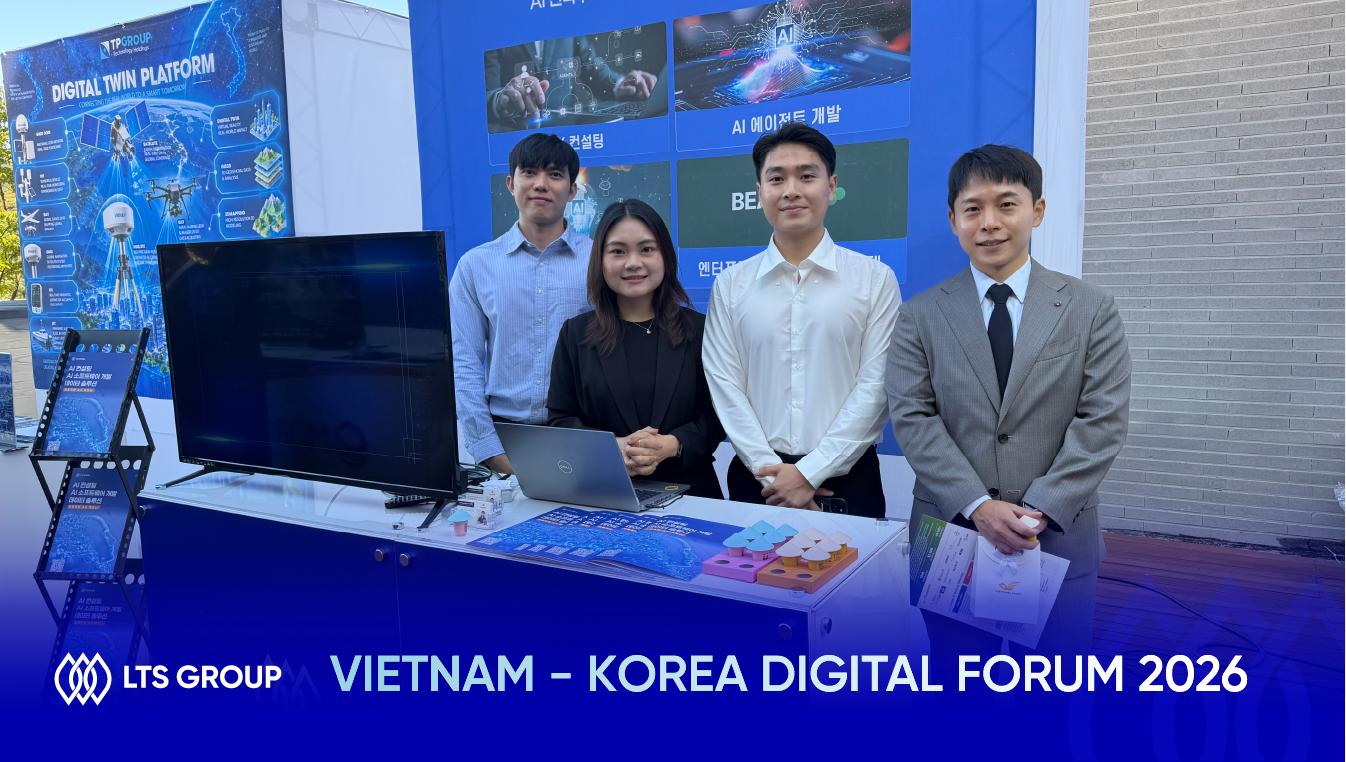
LTS Group Attends Vietnam – Korea Digital Forum 2026: Introduces Beacon for AI Agent Governance
Oct 2, 2026
-5 mins read
On the morning of October 1, 2026, LTS Group attended the Vietnam – Korea Digital Forum 2026 at the Embassy of Vietnam in Seoul. We introduced Beacon, a platform that helps enterprises build, run, and govern AI agents in a single system. A National-level Forum Connecting Vietnam’s and Korea’s Digital Sectors The forum brought together government agencies, industry associations, and digital technology companies from both countries. Vietnam: The Minister of Science and Technology; Mr. Nguyen Khac Lich, Director of the Department of Digital Technology and AI; the Chairman of the Vietnam Software and IT Services Association (VINASA); and digital technology companies including FPT Korea, SotaTek, and LTS Group South Korea: Leaders from the Ministry of Science and ICT (MSIT), the National IT Industry Promotion Agency (NIPA), KT, and other Korean technology companies From “Outsourcing” to “Co-creation” The forum’s message was a shift in Vietnam – Korea cooperation from outsourcing to co-creation, with AI and semiconductors as the two pillars. The keynote session covered five topics: Department of Digital Technology and AI: Co-creating a Vietnam – Korea digital ecosystem, from AI and semiconductors to the global market NIPA: Mechanisms to promote co-development and commercialization of AI and semiconductors, from R&D to market FPT Korea: Creating global value with Vietnamese tech companies, moving from “Outsourcing” to “Co-creation” KT: Next-generation AI infrastructure, with computing and cloud foundations for co-creation SotaTek: Physical AI and AI Factory for smart manufacturing A B2B matching session ran in parallel, focused on AI, semiconductors, cloud, data, software, 5G/6G, information security, and smart factory. Participants discussed finding partners, advancing R&D and PoC projects, and co-developing products. The panel discussion, “Vietnam – Korea Digital Technology Alliance,” centered on three issues: Joint R&D and technology transfer models between research institutes, universities, and businesses in both countries Training high-quality AI engineers and semiconductor design engineers PoC testing mechanisms and bringing co-developed products to the global market The forum closed with a “Make in Viet Nam” solutions showcase, where Vietnamese companies presented their technology capabilities to Korean partners. LTS Group Introduces Beacon – An Enterprise AI Platform As enterprises adopt AI faster, the question is no longer just how to use AI, but how to keep it safe and compliant. Beacon was designed to answer that question. Beacon helps enterprises build, run, and govern AI agents in one system, with compliance built in from the start. Its main capabilities: Full AI stack connectivity: Connects AWS Bedrock, Azure OpenAI, Anthropic, Google Vertex, and more with business tools such as Salesforce, Slack, GitHub, and SharePoint Real-time logging: Records every AI activity across the enterprise as it happens Shadow AI detection: Automatically detects unauthorized AI use On-demand compliance reports: Generates compliance reports whenever needed With Beacon, enterprises can roll out AI quickly while keeping strict access control and infrastructure-level risk management. At our booth, the LTS Group team demonstrated Beacon in person and talked with visitors about enterprise needs in AI governance. Key Takeaways At the forum, we connected with government agencies, associations, and tech companies from both countries and shared insights. Presenting Beacon in person also gave us a firsthand look at what Korean enterprises need in AI governance. It was a valuable opportunity to explore new collaborations and strengthen the Vietnam – Korea digital partnership. With 10 years of experience delivering IT services to global customers, LTS Group will keep developing services and solutions for the Korean market through LTS Korea. In line with the forum’s Co-creation direction, we are committed to being a trusted partner to Korean enterprises, helping them adopt AI effectively, safely, and sustainably.
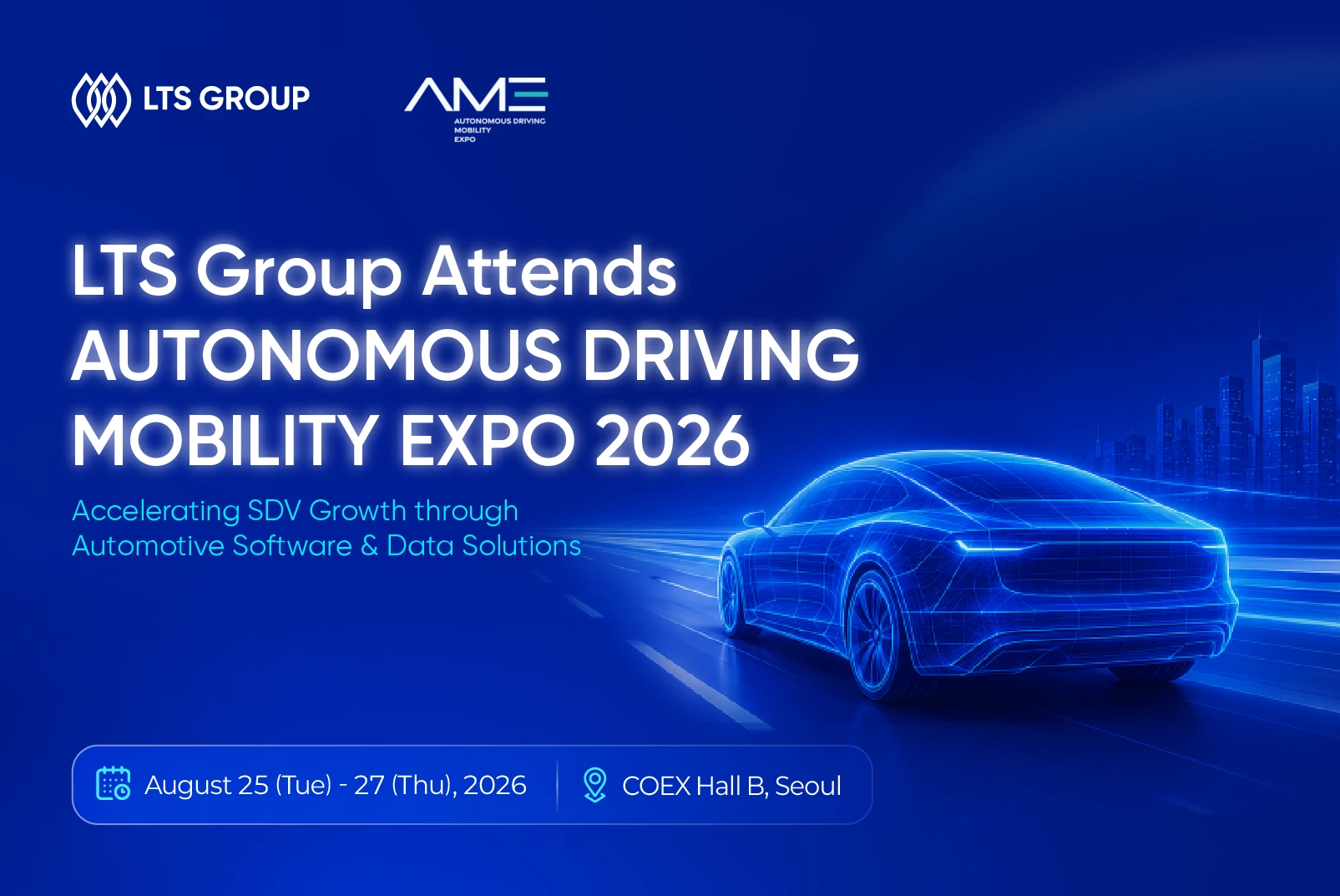
Meet LTS Group at Autonomous Driving Mobility Expo (AME) 2026
Sep 28, 2026
-2 mins read
LTS Group will participate in Autonomous Driving Mobility Expo 2026 (AME 2026), Korea’s largest exhibition dedicated to autonomous driving and future mobility. The event will take place from August 25 to 27, 2026, at Hall B, COEX, Seoul. About AME 2026 AME 2026 will bring together more than 60 exhibitors across 150 booths to showcase the latest technologies and business trends in autonomous driving and future mobility. Held alongside EV Trend Korea 2026, the event will focus on the transition to software-centric vehicle architectures built around software-defined vehicles (SDVs), along with advances in ADAS and autonomous driving technologies. What LTS Group Will Showcase The automotive industry is rapidly evolving as sustainability, intelligent technologies, and service-based models reshape the market. As vehicles become increasingly software-driven, automotive software development, validation, and data labeling for ADAS and autonomous driving are becoming essential to future competitiveness. At AME 2026, LTS Group will showcase: Automotive software development and validation for SDVs; Data labeling solutions for ADAS and autonomous driving; LTS AutoTCGen, an AI-powered tool that generates ASPICE-compliant automotive software test cases (live demo). LTS Group’s CEO, Head of Automotive, Sales Director, and Delivery Manager will be on-site to introduce our solutions and discuss your automotive technology needs. Event Details Date: August 25–27, 2026 Venue: Hall B, COEX, Seoul Visit the LTS Group booth to explore our automotive software development and validation services, ADAS data labeling solutions, and LTS AutoTCGen. To arrange a meeting in advance, don’t hesitate to get in touch with us using the details below!



Email:contact@ltsgroup.tech
Phone:(+84) 96-238-7474
Headquarters:17th Fl, MD Complex Office Building, 68 Nguyen Co Thach Street, Hanoi, Vietnam
Japan:5F, Iwamoto Building, 3-20-10 Shibaura, Minato-ku, Tokyo 108-0023, Japan
US:25787 Rawley Springs Dr, Chantilly, VA 20152
South Korea:Room 1214, 12th Floor, Daerung Seocho Tower, 327 Gangnam-daero, Seocho-gu, Seoul, South Korea
Australia:1/63 Cobden Street, Kew VIC 3101, Australia