MVP in Software Development: A Complete Guide
Sep 18, 2024
-19 min read

Introduced over two decades ago, the concept of a minimum viable product (MVP) remains a fundamental principle in software development. As the originator of the term, the CEO of SyncDev – Frank Robinson – defined an MVP as a product that “is big enough to cause adoption, satisfaction, and sales, but not so big as to be bloated and risky”.
Today, MVP software development is an essential component of the agile methodology, emphasizing iterative improvement and responsiveness to user feedback. Many successful software, such as Facebook, Instagram, Snapchat, Dropbox, and Airbnb, started as MVPs before evolving into their current forms we know now.
In this guide, we’ll explore MVP development comprehensively, from its definition and benefits to detailed steps and more.
What is MVP in Software Development?
An MVP in software development refers to a version of the software that includes only the essential features needed to make the product functional and meet the core requirements.

Consider your organization is developing a new task management solution. The MVP version of this software might include necessary features such as adding tasks, setting due dates, and marking tasks as completed. It would not, however, encompass all the additional features you might plan for future versions like integrations with other applications or advanced analytical tools. The intention is to provide a usable product to users promptly, allowing the business to gather early feedback and make iterative improvements.
By focusing on the core value and limiting the scope of features, an MVP enables developers to avoid unnecessary complexities and reduces time spent on non-essential components. This pragmatic approach highlights that delivering a basic, yet useful, product is often more beneficial than attempting to achieve perfection from the outset.
Does Your Business Need an MVP?
Before actually embarking on the development of an MVP, it’s essential for your company to assess whether an MVP is necessary for your project or not.
Here are 5 major factors to consider:

- Problem complexity
If your project involves complex problems that can benefit from a step-by-step approach, starting with an MVP can help streamline the process.
Conversely, for straightforward issues with minimal complexity, it might be feasible to bypass the MVP and directly build the complete solution.
- Market uncertainty
In uncertain markets, such as those that are constantly evolving or highly competitive, an MVP is great for testing demand and adapting to shifting user preferences.
Meanwhile, in stable markets with well-defined user preferences and clear demand, an MVP may be less ideal.
- Resource availability
If your business has limited resources, an MVP can be an effective strategy to utilize available time, budget, and expertise.
On the other hand, if your company has ample resources, you might consider moving directly to a full-fledged product without an MVP stage.
- Risk tolerance
For companies prioritizing risk mitigation, an MVP offers a way to validate assumptions and reduce potential risks before committing more resources.
But if your stakeholders are comfortable with higher risks or have a well-defined product strategy, you may choose to skip the MVP phase.
- Product viability
When there is uncertainty about your product’s demand or potential success, an MVP offers a controlled environment to certify the idea.
However, if you have strong confidence in the product’s viability and user demand, opting for full-scale development might be the preferred approach.
7 Key Steps in MVP Development Process
Developing an MVP follows a similar path to general software product development, albeit with a strong focus on validating core assumptions, attracting early adopters, and achieving product-market fit early on.
Now, let’s go over 7 crucial stages of MVP for software development!

Step 1. Identify the problem your product should solve
MVP development begins by clearly defining the problem the software seeks to solve.
Here, project leaders must craft a compelling value proposition, which encompasses:
- A defined target audience with distinct needs
- How the product addresses those needs
- The benefits users can expect
To achieve this, your team should do thorough research:
- Market research: Analyzing market size, trends, and identifying target customer demographics, preferences, and pain points.
- Customer interviews and surveys: Directly engaging with potential users to understand their challenges, needs, and opinions on existing solutions.
- Focus groups: Conducting group discussions with a diverse set of prospective customers to gain insights into their attitudes, expectations, and reactions.
- Online polls and social media engagement: Using these tools to collect direct feedback on public interest and trends relevant to your product concept.
Needless to say, this research step is of great significance since, according to CB Insights, a number of startups fail just because they overlook market demand for their products.
Step 2. Analyze the competition
Chances are there are plenty of existing solutions similar to yours in the market.
Therefore, in the next step, we strongly recommend conducting a thorough analysis of direct and indirect competitors and organizing the findings systematically, at least in a spreadsheet for later use.
By identifying similar products, your team has a chance to look closely at how your solution can differentiate itself effectively from rivals.
What’s equally important is estimating market size to ensure there would be enough potential customers willing to buy your product.
Step 3. Define core features
Once you’ve validated your product idea and grasped market dynamics, it’s time to outline the features that will constitute your MVP.
It’s crucial at this stage to adhere strictly to the minimalist philosophy of MVP in development, avoiding the temptation to include every feature intended for the final product.
Prioritizing features is critical, so here are 3 effective prioritization frameworks we highly recommend:

- MoSCoW method: Classifying features as must-have, should-have, could-have, and won’t-have.
- Kano model: Categorizing features into must-be quality (expected features), performance quality (linear impact on satisfaction), and excitement quality (delighters).
- Value vs. effort matrix: Evaluating features based on potential value versus implementation effort.
It’s also advisable to develop a feature roadmap where your team outlines not only MVP features but also those planned for future iterations. This strategic approach guarantees a clear vision beyond the initial release, although further adjustments are inevitable as feedback, data, and insights are constantly gathered throughout the MVP development process.
Step 4. Prototype potential solution
Next is prototyping, which plays a big role in shaping the design and functionality of the final MVP.
It basically involves creating an interactive representation of your concept to map out user flow, estimate development costs, and gather early feedback.
There are various UX tools available including Figma, Marvelapp, Miro, AdobeXD, and Axure, many of which offer free pricing plans.
Once done building a prototype, test it with early adopters to gauge interest in the product and use their feedback to refine the prototype.
Step 5. Develop your MVP
Now, it’s time to bring your MVP to life!
There are several ways to realize your idea, and not all of them demand deep programming expertise:

No-code approach
If your organization does not want to start from scratch and write codes, many methods are available:
- Flintstone method: Operating the product’s functionalities manually behind the scenes until automation becomes feasible.
- Landing page: A simple landing page explaining your product and offering early opt-ins to gain customer insights and leads.
- Constructor method: Combining open-source software and other available platforms to address the problem. While this method may involve integrating different APIs, it’s still far less complex than developing a software from scratch.
In-house development
If your business has the necessary expertise and manpower to develop the MVP internally, this approach is often preferable.
However, MVP agile development isn’t solely about technical know-how; it also needs input from designers, business analysts, and marketers. Therefore, ensure your team has all the required talent in place.
A key thing to note here: doing it yourself expects your team to choose the right tech stack. So below are quick notes to help you make a well-informed decision:
- Consider team expertise: Opt for technologies that are familiar to your team to minimize learning curves and accelerate development.
- Evaluate project needs: Refer to the essential features identified earlier and consult with software engineers to understand technical specifications. Factor in long-term scalability to prevent significant reworks.
Outsourcing development
Another common approach is outsourcing talent or partnering with companies providing MVP software development services.
Platforms like Upwork or Freelancer provide easy access to freelance software engineers, along with their ratings, project histories, and client feedback. However, it’s important to be cautious since hiring freelancers carries numerous risks if your company doesn’t do proper vetting.
For a more reliable approach, organizations should consider partnering with established MVP development companies like LTS Group. Our IT engineers are proficient in a wide array of tech stacks, ensuring we deliver top-tier solutions—from custom mobile and web development to advanced development projects like AI, blockchain, and embedded systems. Whether you require MVP or feature-rich software development solutions, LTS Group is your trusted partner in achieving excellence.

Step 6. Launch, monitor, and improve
Launching your MVP includes several baby steps like deploying, monitoring errors, gathering user feedback, and refining features:
- Deploy your MVP on a server or hosting environment to ensure it runs smoothly in a production setting
- Implement error monitoring and tracking mechanisms to promptly identify and resolve issues
- Prepare for launch activities, including marketing, promotion, and user acquisition strategies
- Collect user feedback diligently and prioritize feature requests and bug fixes to enhance your MVP continuously
Here, your company can adopt 3 main launch approaches to introduce your MVP to the market:

- Soft launch: Releasing your product to a limited user base to mitigate risks, identify bugs, and refine your monetization strategy.
- Hard launch: Executing a widespread release with extensive marketing efforts to attract a broad audience. However, this approach is advisable only when there is a predictable audience.
- Dark launch: Introducing product features gradually to a select group of users to validate functionality and usability in a controlled environment.
Step 7. Prepare to scale
Once your software establishes a solid user base and gathers insights into their needs, it’s essential to prepare for scaling beyond MVP development stages towards a complete solution.
Follow these steps to ensure a smooth transition:
- Clearly outline the complete product’s vision based on user feedback and market analysis
- Develop a detailed product roadmap for feature prioritization and timeline
- Assess your team’s capabilities and expand resources as needed to support the product’s growth trajectory
- Evaluate the MVP’s architecture to accommodate new features and increased complexity
- Adopt an iterative development approach for ongoing enhancements
- Ramp up software testing methods to uphold product reliability and quality standards as you expand
- Publicly release the enhanced product version and closely monitor performance metrics and user feedback
- Finalize and implement a revenue model that aligns with your product’s value proposition and market expectations
Benefits of MVP Development
Software development MVP provides numerous advantages for businesses. Here are 6 key benefits:

- Rapid validation of product viability
MVP enables organizations to swiftly determine if their product concept is viable by offering it to real users for evaluation. With user feedback, your team is equipped with invaluable insights to ensure the product meets the needs of your target audience. This ultimately helps your business avoid investing resources in products that may lack demand or market value.
- Minimized development costs
By focusing on essential features during the MVP development process, your company prevents resource wastage on non-critical components. This leads to reduced development costs and more efficient use of available resources.
- Reduced risks
Testing the market with an MVP eliminates the risk of developing a full product that might not be successful. If the MVP receives positive feedback, then your organization can be more confident about investing additional resources into further development.
- Faster time-to-market
MVP accelerates the software development timeline by prioritizing only core features. This rapid development approach facilitates quicker launch of a functional product, giving your solution an early competitive edge in the market.
- Iterative improvement
An MVP lays the foundation for iterative development. Using user feedback and real-world usage data, project managers can make informed refinements, ensuring the product evolves to meet user needs.
- High adaptability to market changes
The flexibility of an MVP allows a company to quickly adapt to changing market conditions. Starting with a basic version makes it easier for your software to pivot or adjust alongside rapidly-evolving trends.
MVP vs. PoC vs. Prototype
In software development, MVP, proof of concept (PoC), and prototype are terms that are often misunderstood. Let’s clarify each one:

- Proof of Concept
PoC is a preliminary validation of an idea or solution’s technical feasibility.
Typically, a PoC involves creating a simplified version to showcase core functionalities. Its primary goal is to determine if a proposed solution is technically viable and worth further investment.
Check out comprehensive PoC template for your upcoming project.
- Prototype
A prototype is a physical or digital model that represents the design and functionality of a product. It provides a visual and interactive preview of how the final product will look and operate.
Prototypes range from basic sketches to detailed, interactive mock-ups and are used to gather user feedback, test usability, and refine design elements.
- Minimum viable product
Unlike a PoC or prototype, an MVP is a fully functional version of a product with essential features that deliver value to targeted users. It’s developed for actual use by customers and focuses on solving real problems, albeit in a simplified form.
The purpose of an MVP is to collect user feedback, validate assumptions, and iteratively improve the product based on real-world usage.
FAQs about MVP Development
How much does it cost to build an MVP?
Developing a minimum viable product typically costs between $25K and $50K. However, the budget can vary based on the complexity of key features and cutting-edge technologies exploited.
How long should it take to build an MVP?
The timeline for MVP development ranges from 3 to 5 months, depending on factors such as feature complexity, design intricacy, and the resources allocated to the project.
What are some successful MVP software development examples?
Many well-known companies started with MVPs that have evolved into major enterprises, including:
- Amazon: Originated as an online bookstore and expanded into a vast e-commerce platform.
- Airbnb: Began as a platform for renting spare rooms and homes, catering to travelers seeking affordable lodging.
- Dropbox: Initially launched as a file-sharing service with cloud storage, later enhancing features based on user feedback.
- Instagram: Started as a simple photo-sharing app and grew with added functionalities like filters, stories, and video sharing.
How to measure MVP success?
Success metrics for an MVP vary based on your company’s specific goals. However, key indicators of success are:
- User engagement
- Conversion rates
- Retention
- Customer lifetime value (CLV)
- Revenue growth
- Qualitative feedback from users
- Comparisons against industry benchmarks to assess performance relative to competitors.
What are some types of MVP?
MVPs generally fall into two categories:
- Low-fidelity MVPs: These validate core ideas with minimal development, such as pre-order pages or landing pages.
- High-fidelity MVPs: More functional and closer to the final product, offering detailed and interactive experiences, e.g., concierge MVPs, Wizard of Oz MVPs, and single-feature MVPs.
Final Thoughts about MVP Development
MVP development offers significant benefits to businesses by allowing them to test their ideas in the market with minimal investment. This approach ensures concepts are viable and meet market needs before committing to full-scale development, thus reducing risks and optimizing resource allocation.
Hopefully, our detailed guide has been of some help to your business’ MVP development journey.
If your company needs skilled developers to carry out an MVP project, our team at LTS Group is ready to assist. We offer custom web and application development services tailored to meet your unique requirements. Whether it’s full-scale or MVP development services, our solutions are high-quality and efficient to help your business thrive!
- Website: https://ltsgroup.tech/
- Tel: (+84) 24-6660-7474
- Fanpage: https://www.linkedin.com/company/lts-group-vietnam/
Share


Daisy Nguyen
Meet Daisy, a content writer at LTS Group, a renowned IT outsourcing company based in Vietnam. With a passion for crafting compelling narratives, she specializes in producing long-form, thought-provoking articles that delve deep into the realms of technology and innovation. Fueled by an insatiable curiosity, she eagerly explores emerging technologies, seeking to understand their potential impact and share insights with her audience. Contact her at hangnt1@ltsgroup.tech.

More must-reads to keep leaders updated
LTS Group Becomes Official Member of the French Chamber of Commerce and Industry in Vietnam (CCIFV)
Oct 5, 2026
-4 mins read
LTS Group has officially joined the French Chamber of Commerce and Industry in Vietnam (CCIFV), marking a new step in its efforts to strengthen connections with the Vietnam – Europe business community and contribute to technology cooperation between the two markets. Through its CCIFV membership, LTS Group will have opportunities to engage with French and European businesses in Vietnam, as well as industry peers, experts, and decision-makers across sectors. The company plans to take part in networking and knowledge-sharing activities while bringing practical perspectives from its work in AI, software, data, and automotive engineering. As its first engagement, LTS Group will co-host a CCIFV Breakfast Talk in Hanoi on 13 October 2026, focusing on how AI is changing the way we work. A Bridge for Vietnam – Europe Business Cooperation CCIFV supports French and European businesses in Vietnam and promotes economic cooperation between the two markets. As part of the CCI France International network, it connects businesses and chambers of commerce across markets worldwide. Its activities include business networking, Breakfast Talks, sector committees, business support services, and an online member directory that helps members build new connections. Members can also access the wider Vietnam – Europe business network, including connections with EuroCham members, and share company news and expertise through CCIFV’s media channels. From Membership to Practical Contribution Through its CCIFV membership, LTS Group aims to contribute to the community by: Sharing expertise: Bringing practical experience in AI, software, data, and automotive engineering to the CCIFV network; Hosting and speaking at events: Participating in CCIFV activities, starting with the Breakfast Talk “How AI Will Change the Way We Work” on 13th October; Connecting business needs with technology capabilities: Helping European businesses explore technology delivery opportunities in Vietnam. First Engagement: Breakfast Talk on How AI Will Change the Way We Work LTS Group’s first joint activity with CCIFV will be a Breakfast Talk exploring how AI is transforming the workplace. The discussion will cover the foundations organizations need for successful AI adoption, from data and organizational mindset to management strategies. The session will focus on three key areas: Building a strong data foundation: Establishing the groundwork needed for reliable AI initiatives; Developing an AI-native mindset: Helping teams and leaders adapt to working in an increasingly AI-driven environment; Making AI adoption work in practice: Exploring management strategies, including AI sovereignty in Europe and its implications for businesses operating in the global AI landscape. Event Details Date and time: 13 October 2026, 9:00 AM – 11:00 AM Venue: LTS Group Office, 17th Floor, MD Complex Office Building, 68 Nguyen Co Thach Street, Hanoi With hands-on experience in building and validating real-world systems, LTS Group’s specialists will also bring a practical perspective to discussions around AI-driven products, particularly the growing importance of testing, trust, and governance. Our Commitment as a Member of CCIFV For LTS Group, becoming a CCIFV member represents both an opportunity and a commitment: an opportunity to connect with a broader network of European and international organizations, and a commitment to contribute practical experience to the business community. Looking ahead, LTS Group plans to participate actively in CCIFV activities, contribute to sector committee discussions, and explore partnership opportunities with fellow members. By strengthening connections between technology companies and businesses across Vietnam and Europe, LTS Group aims to contribute to a stronger presence for Vietnamese technology companies within the European business ecosystem.
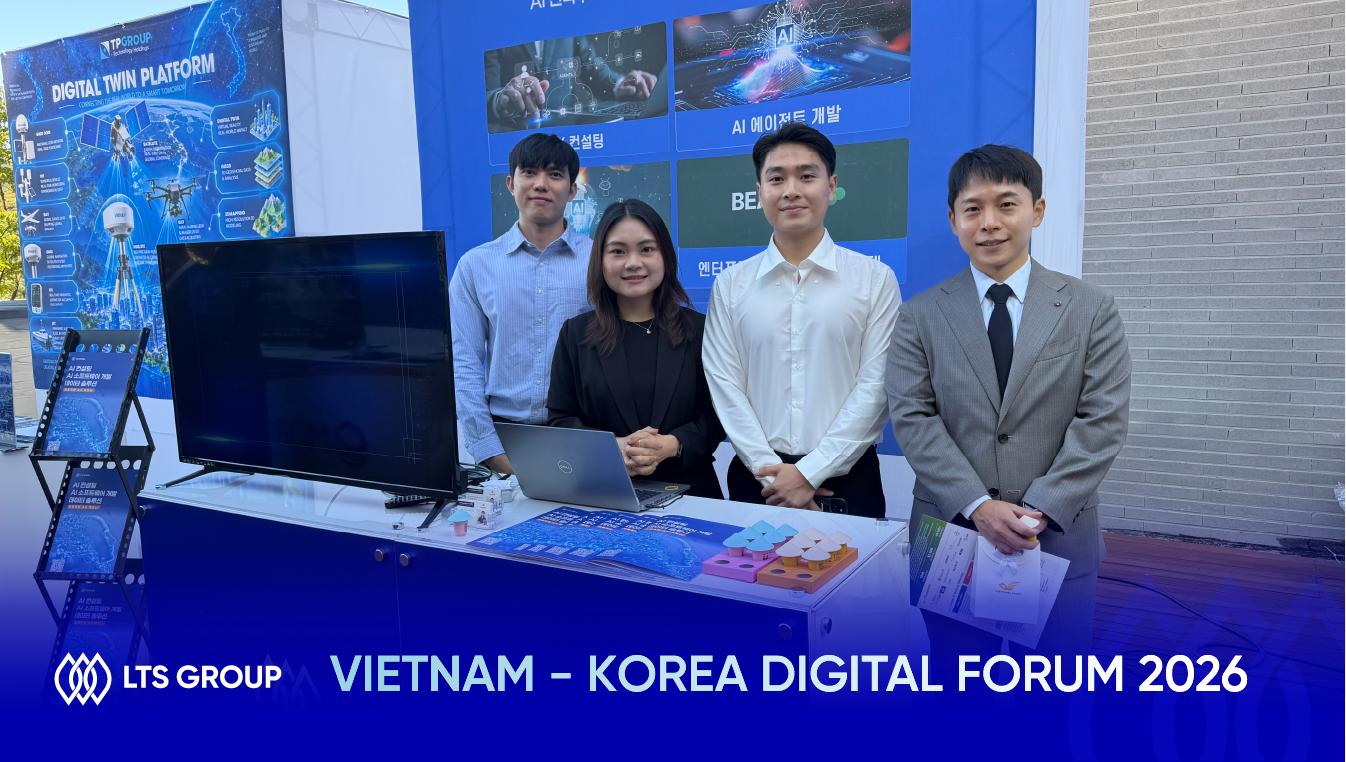
LTS Group Attends Vietnam – Korea Digital Forum 2026: Introduces Beacon for AI Agent Governance
Oct 2, 2026
-5 mins read
On the morning of October 1, 2026, LTS Group attended the Vietnam – Korea Digital Forum 2026 at the Embassy of Vietnam in Seoul. We introduced Beacon, a platform that helps enterprises build, run, and govern AI agents in a single system. A National-level Forum Connecting Vietnam’s and Korea’s Digital Sectors The forum brought together government agencies, industry associations, and digital technology companies from both countries. Vietnam: The Minister of Science and Technology; Mr. Nguyen Khac Lich, Director of the Department of Digital Technology and AI; the Chairman of the Vietnam Software and IT Services Association (VINASA); and digital technology companies including FPT Korea, SotaTek, and LTS Group South Korea: Leaders from the Ministry of Science and ICT (MSIT), the National IT Industry Promotion Agency (NIPA), KT, and other Korean technology companies From “Outsourcing” to “Co-creation” The forum’s message was a shift in Vietnam – Korea cooperation from outsourcing to co-creation, with AI and semiconductors as the two pillars. The keynote session covered five topics: Department of Digital Technology and AI: Co-creating a Vietnam – Korea digital ecosystem, from AI and semiconductors to the global market NIPA: Mechanisms to promote co-development and commercialization of AI and semiconductors, from R&D to market FPT Korea: Creating global value with Vietnamese tech companies, moving from “Outsourcing” to “Co-creation” KT: Next-generation AI infrastructure, with computing and cloud foundations for co-creation SotaTek: Physical AI and AI Factory for smart manufacturing A B2B matching session ran in parallel, focused on AI, semiconductors, cloud, data, software, 5G/6G, information security, and smart factory. Participants discussed finding partners, advancing R&D and PoC projects, and co-developing products. The panel discussion, “Vietnam – Korea Digital Technology Alliance,” centered on three issues: Joint R&D and technology transfer models between research institutes, universities, and businesses in both countries Training high-quality AI engineers and semiconductor design engineers PoC testing mechanisms and bringing co-developed products to the global market The forum closed with a “Make in Viet Nam” solutions showcase, where Vietnamese companies presented their technology capabilities to Korean partners. LTS Group Introduces Beacon – An Enterprise AI Platform As enterprises adopt AI faster, the question is no longer just how to use AI, but how to keep it safe and compliant. Beacon was designed to answer that question. Beacon helps enterprises build, run, and govern AI agents in one system, with compliance built in from the start. Its main capabilities: Full AI stack connectivity: Connects AWS Bedrock, Azure OpenAI, Anthropic, Google Vertex, and more with business tools such as Salesforce, Slack, GitHub, and SharePoint Real-time logging: Records every AI activity across the enterprise as it happens Shadow AI detection: Automatically detects unauthorized AI use On-demand compliance reports: Generates compliance reports whenever needed With Beacon, enterprises can roll out AI quickly while keeping strict access control and infrastructure-level risk management. At our booth, the LTS Group team demonstrated Beacon in person and talked with visitors about enterprise needs in AI governance. Key Takeaways At the forum, we connected with government agencies, associations, and tech companies from both countries and shared insights. Presenting Beacon in person also gave us a firsthand look at what Korean enterprises need in AI governance. It was a valuable opportunity to explore new collaborations and strengthen the Vietnam – Korea digital partnership. With 10 years of experience delivering IT services to global customers, LTS Group will keep developing services and solutions for the Korean market through LTS Korea. In line with the forum’s Co-creation direction, we are committed to being a trusted partner to Korean enterprises, helping them adopt AI effectively, safely, and sustainably.

Meet LTS Group at Autonomous Driving Mobility Expo (AME) 2026
Sep 28, 2026
-2 mins read
LTS Group will participate in Autonomous Driving Mobility Expo 2026 (AME 2026), Korea’s largest exhibition dedicated to autonomous driving and future mobility. The event will take place from August 25 to 27, 2026, at Hall B, COEX, Seoul. About AME 2026 AME 2026 will bring together more than 60 exhibitors across 150 booths to showcase the latest technologies and business trends in autonomous driving and future mobility. Held alongside EV Trend Korea 2026, the event will focus on the transition to software-centric vehicle architectures built around software-defined vehicles (SDVs), along with advances in ADAS and autonomous driving technologies. What LTS Group Will Showcase The automotive industry is rapidly evolving as sustainability, intelligent technologies, and service-based models reshape the market. As vehicles become increasingly software-driven, automotive software development, validation, and data labeling for ADAS and autonomous driving are becoming essential to future competitiveness. At AME 2026, LTS Group will showcase: Automotive software development and validation for SDVs; Data labeling solutions for ADAS and autonomous driving; LTS AutoTCGen, an AI-powered tool that generates ASPICE-compliant automotive software test cases (live demo). LTS Group’s CEO, Head of Automotive, Sales Director, and Delivery Manager will be on-site to introduce our solutions and discuss your automotive technology needs. Event Details Date: August 25–27, 2026 Venue: Hall B, COEX, Seoul Visit the LTS Group booth to explore our automotive software development and validation services, ADAS data labeling solutions, and LTS AutoTCGen. To arrange a meeting in advance, don’t hesitate to get in touch with us using the details below!



Email:contact@ltsgroup.tech
Phone:(+84) 96-238-7474
Headquarters:17th Fl, MD Complex Office Building, 68 Nguyen Co Thach Street, Hanoi, Vietnam
Japan:5F, Iwamoto Building, 3-20-10 Shibaura, Minato-ku, Tokyo 108-0023, Japan
US:25787 Rawley Springs Dr, Chantilly, VA 20152
South Korea:Room 1214, 12th Floor, Daerung Seocho Tower, 327 Gangnam-daero, Seocho-gu, Seoul, South Korea
Australia:1/63 Cobden Street, Kew VIC 3101, Australia