Offshore Software Development Comprehensive Guide for 2025
Apr 24, 2023
-23 mins read

The early days of offshore software development began in 1996 when the US company General Electric opened its first IT center in India where production costs are much lower. Nearly 3 decades later, the offshore development market size has boomed to $122 billion in 2021 and 76% of Deloitte’s surveyed executives indicated that IT functions were outsourced in 2022.

Offshore development can be handled by the company itself or outsourced to a trusted IT outsourcing vendor. But in most cases, companies choose to outsource to simplify the process and reduce headaches.
So, given the trend of IT outsourcing, this article will give you a comprehensive guide to offshore software development outsourcing to help you further understand the context and guide you to make the most out of your outsourcing decision in 2023.
Overview of Offshore Software Development
Let’s understand the basics before we dig deep and figure out if offshore development is the right choice for your company.
What is offshore software development?
Offshore software development is the process in which a business sends its development project to an overseas country where production costs are lower. In the case of offshore outsourcing, the business will hire an offshore software outsourcing provider to handle the task.
For example, a company in the US hires offshore developers in Vietnam to develop an enterprise resource planning (ERP) system.
What types of offshore software development models are there?
There are three common types of offshore development models:
- Fixed price outsourcing model
- Time and Material (T&M) model
- Dedicated team model
1. Fixed-price IT outsourcing model
When a fixed expense is determined before the commencement of the project, it is called the fixed-price model, or project-based offshore development model. This is one of the most popular outsourcing models for clients as it transfers almost all responsibilities and financial risks to the vendor.
Fixed-price IT outsourcing model is ideal when the project comes with clear requirements and expectations for the outputs.
Typically, these projects are small- to mid-size, short-term or one-time, with stable market conditions and unchanged customers’ needs.
2. Time & Material IT outsourcing model
With the T&M model, the clients pay the bill based on the hourly wage and material costs used for the project. This model brings lots of flexibility to the clients and allows them to adjust the plan according to real-time changes and demands.
This model is tailor-made for projects with unclear requirements and timelines, whose aspects can be subject to change, and typically are complex.
3. Dedicated team IT outsourcing model
The dedicated model refers to the case that the vendor provides the client with an exclusive offshore development team. The team then works under the client’s management like a remote in-house team and can be given multiple tasks on multiple projects.
In this model, the team size varies for different projects and the timelines can last for years. This model is often preferred for long-term, high-standard, and flexibility-prioritized projects.
Onshore vs. Nearshore vs. Offshore Outsourcing
Now you know what offshore development is but don’t mix it up with these two similar terms: Onshore and Nearshore.
Here comes a comprehensive comparison of onshore, nearshore, and offshore software development.
| Onshoring | Nearshoring | Offshoring | |
| Location | The vendor is in the same country as the client | The vendor is in a nearby country | The vendor is in an overseas country |
| Common barriers | No barriers of culture, language and timezone difference | Small differences in culture, language and timezone. | Huge differences in culture, language and timezone. |
| Cost reduction | NO | YES in some cases | Definitely YES |
| Example | The client and vendor are in the US | The client is in the US and the vendor is in Canada | The client is in the US and the vendor is in Vietnam |
So, Why Offshore Software Development?
To give you an objective view towards offshore outsourcing, we will go through:
- The pros and cons of offshoring
- When you should hire an offshore development team
Benefits of offshore software development

1. Cost reduction
One of the main reasons leading to offshore development hiring is cost reduction. This is because the top offshore countries like India, Vietnam, Romania, and Poland require lower expenses for operation, infrastructure, and labor than developed countries.
Let’s take the estimated total yearly pay for developers for reference. It takes around $95k for US developers and approximately $23k for developers in Vietnam.
2. Access to talents
By shipping jobs overseas, companies can access a far wider pool of talent and specialized skillsets to get the tasks done well.
Involving people from diverse environments can bring not only diverse tech capabilities but also a fresh perspective to the table. Especially for startups and small companies with limited human resources, offshore outsourcing is truly a great chance to get industry experts to carry out sophisticated tasks.
3. Better localization
In specific cases, an offshore development team helps businesses build more localized software and better implement user-acceptance tests.
Imagine when a European company wants to develop software for Asian users, it’s better to involve Asian developers and testers. They have a deeper understanding of the cultural behaviors of local users and can guarantee better user-friendliness.
4. Extension of working time
Another worth-mentioning advantage of offshore development is the extension of working time thanks to the timezone difference.
By having a remote team taking turns with your in-house team, you can get your tasks processed 24/7.
For illustration, let’s take the story of our client, who is 11 hours far from the Vietnamese timezone. They have users playing their games 24/7 and need to ensure that everything always goes well. For that reason, they have a QA team from LTS Group execute testing whenever their team leaves the office.
Besides the undeniable merits that offshore software development offers, this model poses some challenges. Nothing can help you to avoid obstacles better than being fully aware of them. So, keep scrolling to discover what issues you may encounter.
Challenges Of Offshore Software Development

1. Poor coordination
Poor coordination has always been one of the major offshore software development challenges, which often results from cultural and timezone differences.
In many cases, one business needs an offshore development team to work as a remote in-house team or coordinate with its onsite team for mutual tasks. However, people from different cultural backgrounds can differ in opinions and behaviors, which may make cooperation rockier.
Furthermore, any significant gap in the timezone will bring about middle-of-the-night meetings to handle urgent requests.
Overall, poor coordination may happen and make it challenging to keep everyone on the same page.
2. Poor communication
Poor communication is another critical problem that often results from language and distance barriers in offshore development outsourcing.
The lack of direct communication and language barrier can confuse requirements. Eventually, the misunderstanding will negatively influence the final results and project quality.
3. Flimsy security
The next ever concern in offshore web development is low protection due to distance and the lack of control.
Offshore development outsourcing means letting an external party do your work from a remote location. That’s why, there exist various security risks you might face such as data breaches and code theft, which in any case will lead to tangible and intangible> losses for businesses.
4. Broken process discipline
Another headache when delegating your work to offshore developers is that any discipline can be broken.
For example, a module in the Waterfall development model is passed without enough reviewing and confirmation between you and your vendor.
This is because when sending your job overseas, the timezone difference and the lack of face-to-face meetings may lead to many coordination barriers, making it hard to maintain a strict collaboration schedule.
Even though offshore software development may pose several challenges, in some cases, it is essential to count on an offshore development team. Keep scrolling down to discover when to outsource your projects.
More of this: How to Manage an Offshore Development Team: Important Steps, Challenges, and Extra Tips
So, When Should You Hire An Offshore Development Team?
With the above pros and cons of offshore development, it will be an optimal choice when you want to:
- Concentrate on core activities
- Access to industry experts
- Extend tech capability
- Boost project delivery time
- Reduce software development costs
- Reduce operational costs
How to Set Up an Offshore Development Center?
Now, LTS Group – a trusted offshore development center service provider in Vietnam – will suggest you a framework to effectively set up an offshore development center (ODC). Here are the 6 recommended steps to follow.

1. Goal and vision clarification
The first and foremost step in any outsourcing project is to clarify your project goals and vision, including reasons why you want this offshore development center and your expectation from it. These will significantly affect your decision in the next steps.
For example, if you realize that your software project may last for years and your biggest goal is to reduce cost, you should consider an ODC vendor in stable and low-cost regions like Southeast Asia.
2. Location selection
Choosing an appropriate offshore location will impact your offshore project in terms of costs and stability in the long term.
As of 2023, the top regions for offshore development appear to be South and Southeast Asia, North and Latin America, and Central & Eastern Europe. More specifically, India remains the leading destination, while Vietnam is regarded as a rising star in this domain.
3. Vendor selection
Vendor selection is a critical step to ensure the quality and security of your outsourced project. You can ask for recommendations or go to review platforms to have a list of vendors, then investigate their ability, trustworthiness, and suitability to select the right one.
4. ODC model selection
Now that you already have a suitable vendor, the two parties should agree on an outsourcing model that best facilitates you and your project. There exist 3 common models for you to choose from based on your requirement, time frame and other factors. Please check out the above section on offshore development models for further insights.
5. Offshore development team formation
It’s vital to carefully hand-pick every member of your offshore team, too. You should spend time interviewing and assessing the ability and suitability of the IT developers from outsourcing companies. In any case, remember not to underestimate the language and cultural behaviors aspects to steer clear of potential misleading, inefficiency or poor final work results.
6. Coordination disciplines creation
It’s time to set a guideline for smooth communication and collaboration to minimize the challenges and maximize the benefits of offshore development. The way you present this guideline and decide its coverage depends on specific situations, but it should at least cover:
- Tracking tools
- Communication tools
- Report and meeting time
More on this: Essential guide for offshore development center setup
Offshore Software Development Rates by Region and Country
Offshore rates for software development directly affect IT outsourcing budget, hence is an important factor to consider before setting up an ODC.
The rates will vary by region and country, and even within each country based on different seniorities and skill sets.
As said before, in 2023, the most popular regions for IT outsourcing are South and Southeast Asia, North and Latin America, and Central & Eastern Europe. Here is an infographic featuring offshore developer rates ranges for each area.

More specifically, we have software outsourcing hourly rates by skills and seniority in each region as below.

In terms of the average software engineering salary by country which can partially represent offshore application development costs and offshore software development rates, here is a list of software developer salaries from the lowest to the highest countries:
| Country | Software developer monthly salary (USD) |
| India | 10,236 |
| Nigeria | 10,560 |
| China | 11,174 |
| Philippines | 18,684 |
| Vietnam | 23,736 |
| Argentina | 32,835 |
| Brazil | 42,100 |
| Mexico | 42,379 |
| France | 49,595 |
| Singapore | 50,160 |
| UK | 50,526 |
| Japan | 53,900 |
| Poland | 57,960 |
| New Zealand | 63,537 |
| Canada | 63,571 |
| Ireland | 66,490 |
| Germany | 69,869 |
| Australia | 80,500 |
| Denmark | 86,924 |
| Finland | 98,100 |
| Switzerland | 100,000 |
| United States | 106,275 |
Source: Glassdoor
The list reveals that the highest-paying countries for software developers are the US, Switzerland, Finland, and Denmark.
And the most budget-friendly countries in terms of software development costs are India, Nigeria, China, the Philippines, and Vietnam.
How to Choose an Offshore Software Outsourcing Company?
Selecting the right vendor helps you make the benefits outweigh the risks in IT outsourcing. Hence, keeps these criteria in mind to choose the most suitable IT outsourcing company.

1. Transparency
Transparency is the top qualitative aspect that a business should consider when choosing a remote IT outsourcing partner.
A transparent IT vendor is a partner willing to clarify potential issues concerning your project and how they will resolve them, inform you early and exactly what is happening during the development process to avoid issue escalation.
2. Understanding your business
Understanding your business is another paramount factor to ensure project quality and close relationships. A vendor who attempts to understand your business model, business culture, and project vision is more likely to smoothly collaborate and provide innovative yet vision-aligned software that solves your end-users’ pain points.
3. Strong and relevant portfolio
It’s vital to investigate if they have a quality experience, too. Check references, past clients, feedback and their development portfolio, especially the ones relevant to your upcoming project. These will give you an idea of their offshore web development services, work style, capability, and trustworthiness.
4. Clear and frequent communication
Communication is another key to effective IT outsourcing. Your potential software development vendor should fluently communicate in your preferred language and support your prioritized communication tools. They should also guarantee a regular meeting schedule to report the current working process or any issue that arises.
Surprised as you may feel, all of these start with their quick responses to you right from the beginning.
5. Cost-effectiveness
Pricing is always a deciding factor in outsourcing decisions. You should check their available outsourcing pricing models and the estimated cost for your project before picking your vendor.
6. Timeline guarantee
Working without direct interaction and complete control may be challenging for you to keep track of the progress. To ensure the offshore development team delivers the product on time, you should ask if they can meet the given deadline and their responsibilities in case of delay.
7. Skillful software engineers
As accessing new capabilities and industry experts are a major purpose of IT outsourcing, top IT talent is a must criterion.
To make sure you have a team of high-quality IT engineers to take care of your project, you should spend time reviewing their software developers’ CVs and accessing them during interviews.
Also, that the company invests in training IT talents will be a bonus during vendor selection. For instance, LTS Group has its IT academy – LTS Edu to spot and nurture top talents for businesses around the globe.
8. Clear security standards
Security standards vary from project to project, but there are three common types of security that outsourcing companies apply as follows:
- Physical security layers: CCTV system, fingerprint scanner, separated working space, etc.
- Legal confidentiality: NDA (Non-disclosure agreement).
- Network security: VPN (Virtual private network), data leak prevention solutions, etc.
Want a further detailed guide on vendor selection? Check out 12 questions to ask to hire the right software vendor for business owners now!
Offshore Software Outsourcing Trends in 2023
So, amid the current world context and the fast-evolving nature of technology, what IT outsourcing trends will take the spotlight in 2023?
Multi-partner sourcing
Going through the current instabilities in 2022, ranging from the Russian invasion of Ukraine to China’s strict pandemic lockdown, business owners have realized the urge for software vendor diversification to not over-rely on a single supplier or country.
That’s why in 2023, there will be a movement from single-vendor management to holistic ecosystem management, in which aligning multiple software vendors on a single objective will be quite challenging for the first time.
High priority over cybersecurity
When asked “What are your expectations from your use of third-party services?”, cybersecurity topped the answer of 81% of surveyees of the 2022 Deloitte Global Outsourcing Survey.
In 2022, according to Cyberseek, unfilled cybersecurity jobs in the United States hit a record 465,000 which is approximately half the total cyber positions. Meanwhile, 83% of IT leaders with in-house security teams are considering outsourcing in 2023.
Increased demand for cloud services
In light of the continuous thriving demand for cloud integration, cloud technology implementation is projected to be a high-demand function that businesses expect their offshore vendor to handle in 2023.
According to Yahoo Finance: “Cloud services market to surpass US$ 4.4 trillion by 2033”, in which SMEs group comes with the highest demand.
And last, qualitative aspects over quantitative aspects
Cost-effectiveness used to be the primary key in vendor selection and cost-reduction used to be the top reason for offshoring for many decades.
Yet in 2023 and the near future, the most influential factors in vendor selection are shifting to qualitative aspects like “transparency” and “understanding of our business”, while the top reasons for outsourcing are changing to the prioritization of capabilities and keeping up with technology and regulatory changes.
FAQs About Offshore Software Development
1. How to manage your offshore developers?
Working with an outsourced and remote team is not always simple but definitely manageable. Here are tips to effectively manage an offshore development team:
- Ensure that everyone is on the same page: Before kickstarting your project, spend some time to ensure that everyone understands your product vision and aligns it with their capabilities.
- Set milestones and deliverables: Setting clear and achievable milestones for your remote developers gives them clear ideas of their responsibilities and facilitates you in tracking as well.
- Eliminate micromanagement: Once you’ve decided on your offshore team members, empower them and look at the big picture instead of paying attention to every small detail of their work.
- Treat them like your team: Give them real work to do and engage them in relevant decision-making processes. Avoid an “us vs them” mentality and treat them like they are a true part of your internal team.
2. What services can be outsourced?
Fortunately, almost all IT tasks can be outsourced to an offshore software vendor. The most commonly outsourced processes are:
- Mobile app development
- Web app development
- Software maintenance
- Cloud integration
- UI/UX design
- Software quality assurance (QA) and testing
3. What are the best countries for offshore software development?
As of 2023, the most popular destinations for IT outsourcing are:
- India – the leading country for offshoring for many years.
- Vietnam – an emerging IT outsourcing country thanks to competitive pricing, abundant IT talent, fast post-pandemic recovery, and an open business environment.
- The Philippines – a budget-friendly IT outsourcing country with favorable governmental policies for foreign investors and ICT services.
- Poland – a favored country for IT outsourcing is the high quality of its services and highly-competent technical staff.
- Romania – a preferred offshoring destination thanks to a large talent pool of highly skilled developers, reasonable rates, and a stable economy.
Explore more: Why IT outsourcing to Vietnam?
Conclusion
You’ve gone through a thorough guide on offshore software development by LTS Group. That’s quite a lot of knowledge, we know. But it will give you an overview of offshore development and guide you to make the most out of your outsourcing decision in 2023.
As one of the leading IT solutions providers in Vietnam who has worked with clients in 11 countries, we understand every challenge that a business may face when delegating part of the business to an overseas vendor. Don’t hesitate to tell us your story and let us help you solve the pain and maximize the gain.
Website: https://ltsgroup.tech/
Tel: (+84) 24-6660-7474
Fanpage: https://www.linkedin.com/company/lts-group-vietnam/
Share


Linh Tran
Meet Linh - an intellectually curious researcher who seeks answers to deep questions. Linh is eager to learn about business and digital transformation, and enthusiastic about deriving data-driven actionable insights to enhance business outcomes. Contact her at celine@ltsgroup.tech.

More must-reads to keep leaders updated
LTS Group Becomes Official Member of the French Chamber of Commerce and Industry in Vietnam (CCIFV)
Oct 5, 2026
-4 mins read
LTS Group has officially joined the French Chamber of Commerce and Industry in Vietnam (CCIFV), marking a new step in its efforts to strengthen connections with the Vietnam – Europe business community and contribute to technology cooperation between the two markets. Through its CCIFV membership, LTS Group will have opportunities to engage with French and European businesses in Vietnam, as well as industry peers, experts, and decision-makers across sectors. The company plans to take part in networking and knowledge-sharing activities while bringing practical perspectives from its work in AI, software, data, and automotive engineering. As its first engagement, LTS Group will co-host a CCIFV Breakfast Talk in Hanoi on 13 October 2026, focusing on how AI is changing the way we work. A Bridge for Vietnam – Europe Business Cooperation CCIFV supports French and European businesses in Vietnam and promotes economic cooperation between the two markets. As part of the CCI France International network, it connects businesses and chambers of commerce across markets worldwide. Its activities include business networking, Breakfast Talks, sector committees, business support services, and an online member directory that helps members build new connections. Members can also access the wider Vietnam – Europe business network, including connections with EuroCham members, and share company news and expertise through CCIFV’s media channels. From Membership to Practical Contribution Through its CCIFV membership, LTS Group aims to contribute to the community by: Sharing expertise: Bringing practical experience in AI, software, data, and automotive engineering to the CCIFV network; Hosting and speaking at events: Participating in CCIFV activities, starting with the Breakfast Talk “How AI Will Change the Way We Work” on 13th October; Connecting business needs with technology capabilities: Helping European businesses explore technology delivery opportunities in Vietnam. First Engagement: Breakfast Talk on How AI Will Change the Way We Work LTS Group’s first joint activity with CCIFV will be a Breakfast Talk exploring how AI is transforming the workplace. The discussion will cover the foundations organizations need for successful AI adoption, from data and organizational mindset to management strategies. The session will focus on three key areas: Building a strong data foundation: Establishing the groundwork needed for reliable AI initiatives; Developing an AI-native mindset: Helping teams and leaders adapt to working in an increasingly AI-driven environment; Making AI adoption work in practice: Exploring management strategies, including AI sovereignty in Europe and its implications for businesses operating in the global AI landscape. Event Details Date and time: 13 October 2026, 9:00 AM – 11:00 AM Venue: LTS Group Office, 17th Floor, MD Complex Office Building, 68 Nguyen Co Thach Street, Hanoi With hands-on experience in building and validating real-world systems, LTS Group’s specialists will also bring a practical perspective to discussions around AI-driven products, particularly the growing importance of testing, trust, and governance. Our Commitment as a Member of CCIFV For LTS Group, becoming a CCIFV member represents both an opportunity and a commitment: an opportunity to connect with a broader network of European and international organizations, and a commitment to contribute practical experience to the business community. Looking ahead, LTS Group plans to participate actively in CCIFV activities, contribute to sector committee discussions, and explore partnership opportunities with fellow members. By strengthening connections between technology companies and businesses across Vietnam and Europe, LTS Group aims to contribute to a stronger presence for Vietnamese technology companies within the European business ecosystem.
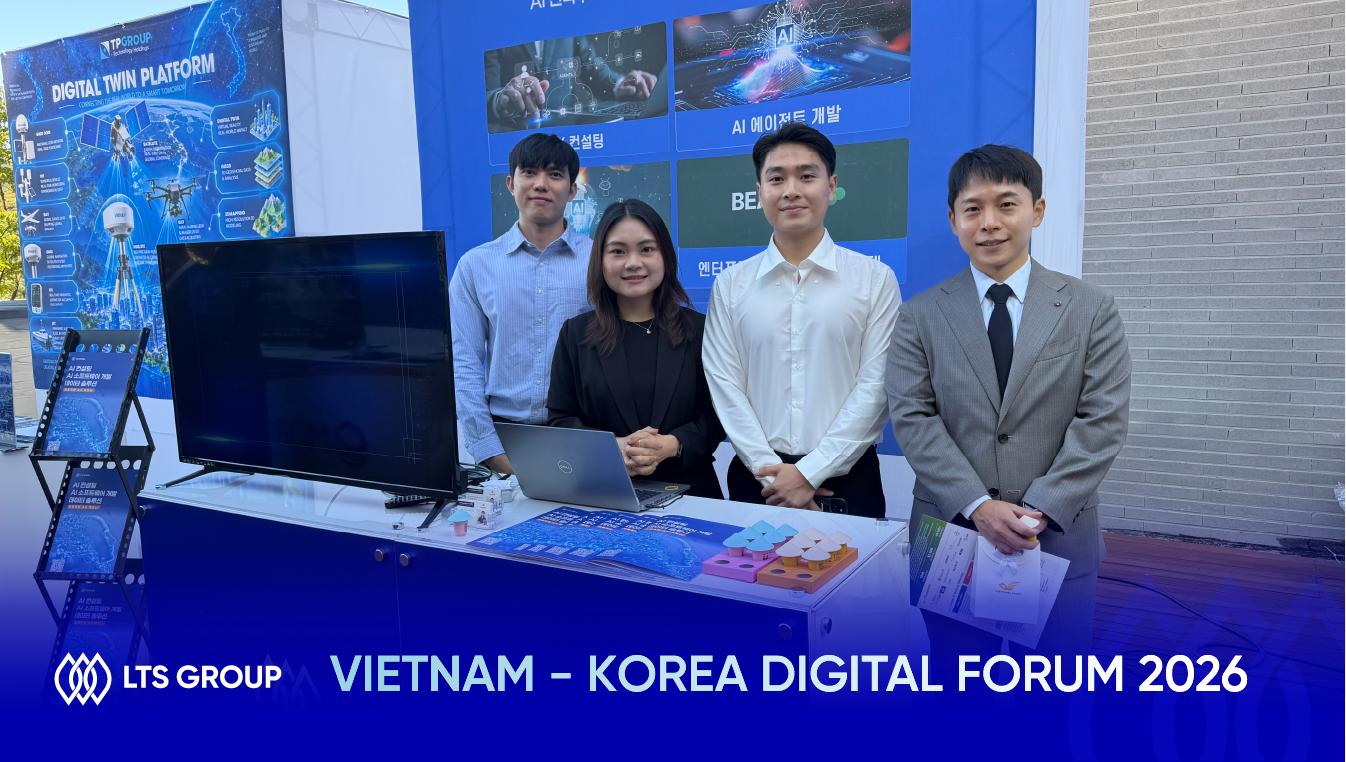
LTS Group Attends Vietnam – Korea Digital Forum 2026: Introduces Beacon for AI Agent Governance
Oct 2, 2026
-5 mins read
On the morning of October 1, 2026, LTS Group attended the Vietnam – Korea Digital Forum 2026 at the Embassy of Vietnam in Seoul. We introduced Beacon, a platform that helps enterprises build, run, and govern AI agents in a single system. A National-level Forum Connecting Vietnam’s and Korea’s Digital Sectors The forum brought together government agencies, industry associations, and digital technology companies from both countries. Vietnam: The Minister of Science and Technology; Mr. Nguyen Khac Lich, Director of the Department of Digital Technology and AI; the Chairman of the Vietnam Software and IT Services Association (VINASA); and digital technology companies including FPT Korea, SotaTek, and LTS Group South Korea: Leaders from the Ministry of Science and ICT (MSIT), the National IT Industry Promotion Agency (NIPA), KT, and other Korean technology companies From “Outsourcing” to “Co-creation” The forum’s message was a shift in Vietnam – Korea cooperation from outsourcing to co-creation, with AI and semiconductors as the two pillars. The keynote session covered five topics: Department of Digital Technology and AI: Co-creating a Vietnam – Korea digital ecosystem, from AI and semiconductors to the global market NIPA: Mechanisms to promote co-development and commercialization of AI and semiconductors, from R&D to market FPT Korea: Creating global value with Vietnamese tech companies, moving from “Outsourcing” to “Co-creation” KT: Next-generation AI infrastructure, with computing and cloud foundations for co-creation SotaTek: Physical AI and AI Factory for smart manufacturing A B2B matching session ran in parallel, focused on AI, semiconductors, cloud, data, software, 5G/6G, information security, and smart factory. Participants discussed finding partners, advancing R&D and PoC projects, and co-developing products. The panel discussion, “Vietnam – Korea Digital Technology Alliance,” centered on three issues: Joint R&D and technology transfer models between research institutes, universities, and businesses in both countries Training high-quality AI engineers and semiconductor design engineers PoC testing mechanisms and bringing co-developed products to the global market The forum closed with a “Make in Viet Nam” solutions showcase, where Vietnamese companies presented their technology capabilities to Korean partners. LTS Group Introduces Beacon – An Enterprise AI Platform As enterprises adopt AI faster, the question is no longer just how to use AI, but how to keep it safe and compliant. Beacon was designed to answer that question. Beacon helps enterprises build, run, and govern AI agents in one system, with compliance built in from the start. Its main capabilities: Full AI stack connectivity: Connects AWS Bedrock, Azure OpenAI, Anthropic, Google Vertex, and more with business tools such as Salesforce, Slack, GitHub, and SharePoint Real-time logging: Records every AI activity across the enterprise as it happens Shadow AI detection: Automatically detects unauthorized AI use On-demand compliance reports: Generates compliance reports whenever needed With Beacon, enterprises can roll out AI quickly while keeping strict access control and infrastructure-level risk management. At our booth, the LTS Group team demonstrated Beacon in person and talked with visitors about enterprise needs in AI governance. Key Takeaways At the forum, we connected with government agencies, associations, and tech companies from both countries and shared insights. Presenting Beacon in person also gave us a firsthand look at what Korean enterprises need in AI governance. It was a valuable opportunity to explore new collaborations and strengthen the Vietnam – Korea digital partnership. With 10 years of experience delivering IT services to global customers, LTS Group will keep developing services and solutions for the Korean market through LTS Korea. In line with the forum’s Co-creation direction, we are committed to being a trusted partner to Korean enterprises, helping them adopt AI effectively, safely, and sustainably.

Meet LTS Group at Autonomous Driving Mobility Expo (AME) 2026
Sep 28, 2026
-2 mins read
LTS Group will participate in Autonomous Driving Mobility Expo 2026 (AME 2026), Korea’s largest exhibition dedicated to autonomous driving and future mobility. The event will take place from August 25 to 27, 2026, at Hall B, COEX, Seoul. About AME 2026 AME 2026 will bring together more than 60 exhibitors across 150 booths to showcase the latest technologies and business trends in autonomous driving and future mobility. Held alongside EV Trend Korea 2026, the event will focus on the transition to software-centric vehicle architectures built around software-defined vehicles (SDVs), along with advances in ADAS and autonomous driving technologies. What LTS Group Will Showcase The automotive industry is rapidly evolving as sustainability, intelligent technologies, and service-based models reshape the market. As vehicles become increasingly software-driven, automotive software development, validation, and data labeling for ADAS and autonomous driving are becoming essential to future competitiveness. At AME 2026, LTS Group will showcase: Automotive software development and validation for SDVs; Data labeling solutions for ADAS and autonomous driving; LTS AutoTCGen, an AI-powered tool that generates ASPICE-compliant automotive software test cases (live demo). LTS Group’s CEO, Head of Automotive, Sales Director, and Delivery Manager will be on-site to introduce our solutions and discuss your automotive technology needs. Event Details Date: August 25–27, 2026 Venue: Hall B, COEX, Seoul Visit the LTS Group booth to explore our automotive software development and validation services, ADAS data labeling solutions, and LTS AutoTCGen. To arrange a meeting in advance, don’t hesitate to get in touch with us using the details below!



Email:contact@ltsgroup.tech
Phone:(+84) 96-238-7474
Headquarters:17th Fl, MD Complex Office Building, 68 Nguyen Co Thach Street, Hanoi, Vietnam
Japan:5F, Iwamoto Building, 3-20-10 Shibaura, Minato-ku, Tokyo 108-0023, Japan
US:25787 Rawley Springs Dr, Chantilly, VA 20152
South Korea:Room 1214, 12th Floor, Daerung Seocho Tower, 327 Gangnam-daero, Seocho-gu, Seoul, South Korea
Australia:1/63 Cobden Street, Kew VIC 3101, Australia